
How to Source Bluetooth Speakers from China in 2026: Supplier, Quality and Compliance Guide

A Bluetooth speaker looks simple from the outside. A grille, a plastic or metal body, a battery, a charging port, and a few buttons. In production, though, small choices can change the result quickly: driver matching, passive radiator size, amplifier tuning, battery cell quality, glue control, waterproof sealing, carton drop protection, and the paperwork needed to sell the product in your market.
That is why a sourcing guide for Bluetooth speakers should not read like an acoustic design manual. Most importers do not need to calculate every driver parameter themselves. They need to find the right Chinese supplier, approve the right sample, lock the right quality standard, and avoid paying for a product that cannot pass inspection or compliance review.
This 2026 guide is written from the buyer side: what to check before you choose a factory, what to ask during sampling, and how to reduce the risk before you pay the balance.
1. Start with the sales channel and target market
Before asking factories for prices, define where the speaker will be sold. A Bluetooth speaker for Amazon US, a retail chain in the EU, a promotional gift order, and an outdoor brand project may all use different test standards, packaging, battery documentation, and after-sales expectations.
For the US market, RF products normally need FCC equipment authorization before import or marketing. For the EU, buyers need to consider CE marking responsibilities, and electronic products may also need RoHS documentation. Bluetooth branding adds another layer: Bluetooth SIG states that Bluetooth products must complete the qualification process before sale or distribution.
- Target country and sales channel
- Retail packaging language and warning labels
- Battery capacity, charging cable, adapter policy, and transport documents
- Required certificates and test reports
- Warranty expectations and replacement rate tolerance
2. Choose the supplier type before comparing prices
Many Bluetooth speaker suppliers in China are not the same type of company. Some are assembly factories with in-house plastic injection, some focus on electronics assembly, some are trading companies with access to several factories, and some are product development companies that manage tooling, acoustic tuning, and packaging.
The lowest quotation is often hard to compare because suppliers may include different parts: battery grade, speaker driver, amplifier chip, waterproof structure, fabric quality, carton thickness, test time, and after-sales spare parts. Ask each supplier to quote against the same specification sheet. If they cannot explain the cost difference, do not treat the price as reliable.
- Ask which processes are done in-house and which are outsourced.
- Request photos or a live video call of assembly, aging test, battery test, and packing areas.
- Confirm who owns tooling, firmware files, test fixtures, and the golden sample.
- Check whether the supplier has shipped similar speakers to your target market.
3. Build a clear specification sheet
A Bluetooth speaker specification should be more than size, color, and power output. A practical buyer spec should include Bluetooth version, supported profiles, battery capacity, charging port, charging time, playback time test condition, rated output, speaker driver size, waterproof rating if claimed, housing material, packaging method, accessories, label content, and inspection criteria.
Be careful with marketing numbers. “10W,” “20 hours battery life,” and “IPX7 waterproof” mean little if the test condition is not written down. Ask the supplier how each claim is measured. A serious supplier will give a test method or at least explain the condition behind the number.
4. Use samples to compare suppliers, not just sound
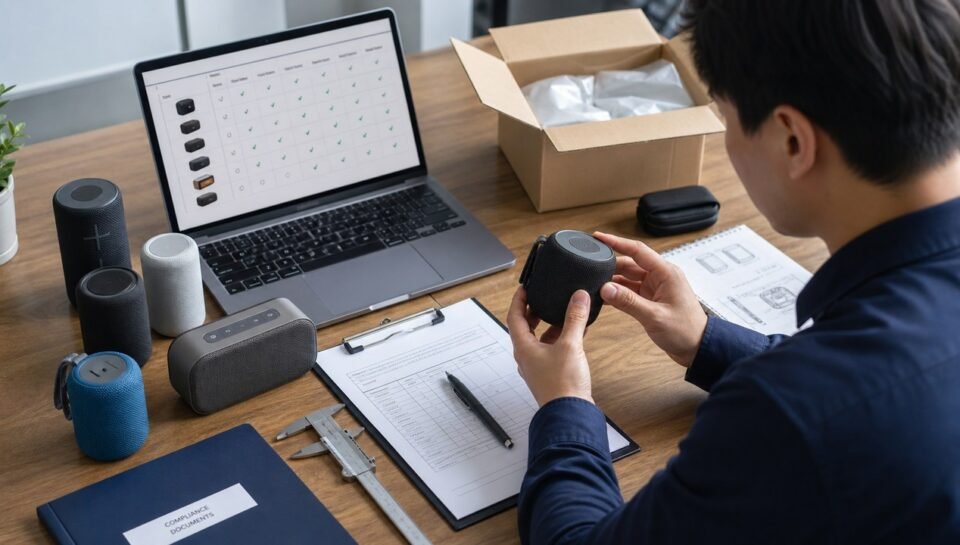
Sound quality matters, but a buyer should test more than bass and loudness. I like to compare samples on practical failure points: Bluetooth reconnection, charging heat, button feel, grille alignment, cabinet vibration, rubber part fit, fabric wrinkles, battery runtime, cosmetic defects, and carton protection.
Approve one golden sample only after the supplier confirms the BOM and production method. If the sample uses a better battery, different driver, thicker fabric, or hand-tuned firmware that will not be used in mass production, the sample is not a real production reference.
- Test at low, medium, and high volume.
- Check Bluetooth connection distance and reconnection after power cycling.
- Run a charging and battery runtime check.
- Inspect glue lines, seams, fabric, buttons, ports, and logo placement.
- Drop-test the retail box and master carton if the product will ship by parcel.
5. Confirm compliance before mass production
Compliance is where many small speaker projects become expensive. A supplier may show old FCC, CE, RoHS, or battery reports from a similar model. That does not automatically cover your product, your brand, your model number, or your market. Ask whether the report matches the exact PCB, Bluetooth module, battery, antenna, enclosure, and model name.
For Bluetooth qualification, the buyer should know whether the product is being resold under the supplier’s model or sold under the buyer’s own brand and model. Bluetooth SIG says a supplier cannot qualify your product on your behalf if it is your product under your company account. Buyers should check this before printing packaging with Bluetooth marks.
Useful official references: Bluetooth SIG qualification, FCC equipment authorization, European Commission CE marking, and EU RoHS Directive.
6. Lock quality requirements before paying the deposit
Do not wait until inspection day to define quality. The purchase order should state the approved sample version, packaging artwork version, critical dimensions, cosmetic limits, functional tests, battery and charging checks, waterproof test if applicable, carton drop test, and the inspection standard used before balance payment.
For Bluetooth speakers, I would normally treat safety, charging, battery swelling, no power, Bluetooth failure, distorted sound, wrong labels, and serious cosmetic defects as critical or major issues. Minor color shade or tiny surface marks may be handled differently, but that needs to be written before production starts.
7. Plan inspection around the real risk
A pre-shipment inspection should not be a quick photo check. Inspectors should open cartons, count accessories, compare labels, run functional tests, check charging, listen for speaker distortion, verify Bluetooth pairing, inspect packaging, and compare the goods with the approved sample.
For a first order, consider checking during production as well. Early inspection can catch wrong components, wrong packaging, or assembly problems before the full batch is finished. Once all speakers are packed, every fix is slower and more expensive.
8. Check packaging and logistics early
Bluetooth speakers are often damaged by weak packaging as much as poor assembly. A good carton plan should protect corners, buttons, grilles, and charging ports. If the product will be shipped by courier or sold through e-commerce, ask for a package drop test and review the master carton weight.
Battery documents also matter. Ask the supplier or freight forwarder about lithium battery transport documents, carton marks, MSDS, UN38.3 test summary if needed, and whether the shipment will move by air, sea, rail, or courier. Do this before production, not after the goods are waiting in the warehouse.
9. A practical sourcing checklist
- Define target market, sales channel, and compliance needs.
- Compare supplier type and production control before you compare unit price.
- Build a written specification sheet before sampling.
- Approve a golden sample tied to a confirmed BOM.
- Check certificates against the exact model and market.
- Set inspection criteria before deposit payment.
- Inspect packaging, labels, battery documents, and shipping plan.
If you are sourcing Bluetooth speakers from China and want local support with supplier screening, sample comparison, quality inspection, compliance document review, or shipment follow-up, Direct Sourcing China can help manage the process before your order turns into a costly problem.
Related reading: How to Verify a Chinese Supplier Before Paying a Deposit, Quality Inspection China, and Direct Sourcing China Products.
Yes, especially for importers who need speaker assembly, plastic tooling, acoustic tuning, packaging, and export support in one supply chain. The buyer still needs to verify the factory role, test samples carefully, and confirm compliance documents before mass production.
MOQ depends on the model, tooling, battery, packaging, and customization. Existing private-label models may start lower, while custom housings, special fabric, custom PCB layouts, or new packaging usually require higher MOQ and longer lead time.
At minimum, check sound balance, Bluetooth stability, battery runtime, charging safety, button feel, waterproof claims if any, drop resistance, cosmetic finish, packaging protection, and label accuracy. For a new supplier, test more than one sample.
Usually yes, depending on the target market and product design. Importers should confirm RF, safety, EMC, battery, RoHS, and Bluetooth qualification responsibilities before placing a large order.
A sourcing agent is useful when you need factory screening, sample comparison, production follow-up, inspection, compliance document review, and shipment coordination. It is less necessary if you already have a tested supplier and your own QC team in China.