
Bluetooth Earbuds OEM Quality Control Checklist for Importers

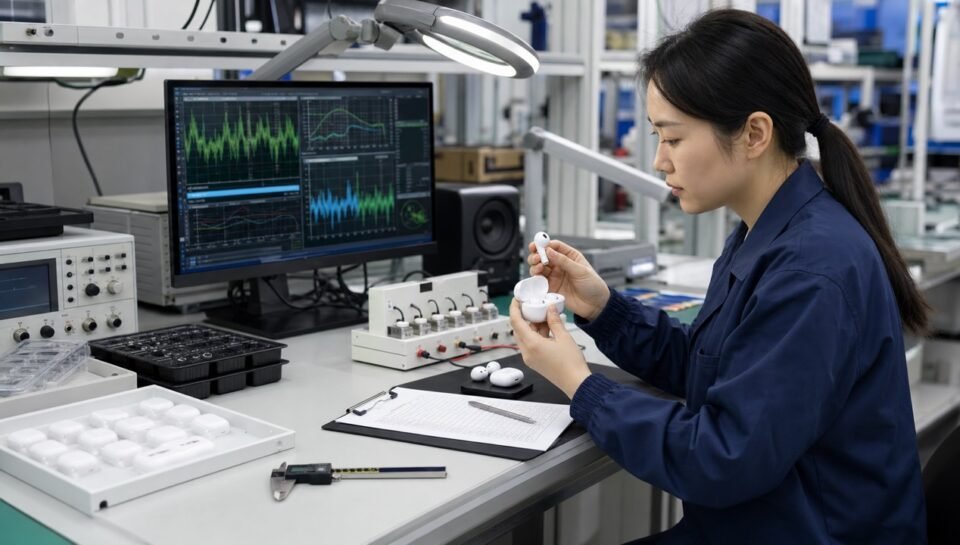
A Bluetooth earbud can pair successfully and still be a bad product. One side may play 2 dB louder than the other. The microphone may sound acceptable in a quiet office but collapse beside traffic. The charging case may pass a five-minute check and fail after a week of repeated use.
This is why an OEM inspection cannot stop at appearance, pairing, and a short music test. Importers need an agreed specification, a signed reference sample, measurable limits, and a repeatable inspection method.
The checklist below is written for true wireless stereo (TWS) earbuds made by an OEM or ODM factory. It covers production approval and pre-shipment inspection, with extra attention to the failures that create returns after launch.
Start with a quality specification, not a catalog page
A factory cannot control a requirement that was never defined. Before production, convert sales language such as “deep bass,” “clear calls,” and “long battery life” into testable limits.
Your product specification should identify the approved chipset, Bluetooth version, codec support, driver, microphone arrangement, battery cells, charging connector, materials, colors, firmware version, accessories, and packaging. Add pass/fail criteria for the functions that matter to the customer.
Keep one signed golden sample with the factory and another with your team or inspection company. Both samples should use the approved production firmware. A hand-tuned engineering sample is a poor reference if the mass-production line cannot reproduce it.
1. Verify the production configuration
Component substitution is one of the hardest earbud problems to detect from the outside. Two units can share the same housing while using different drivers, batteries, microphones, or memory. The sound, call quality, standby current, and reliability may all change.
- Match the production bill of materials to the approved BOM.
- Record the Bluetooth chipset and firmware build.
- Check driver supplier, model, impedance, and sensitivity.
- Verify microphone model and orientation.
- Confirm earbud and case battery suppliers, capacities, and date codes.
- Check PCB revision and charging-case controller.
For higher-risk orders, open a controlled number of units and photograph the internal parts. This is more useful than accepting a general statement that the product uses “the same components as the sample.”
2. Inspect appearance and mechanical assembly
Cosmetic defects are easy to see, but the inspection conditions still need to be consistent. Define viewing distance, lighting, inspection time, and the surfaces that count as customer-facing areas.
- Compare color and gloss with the approved sample.
- Check gaps, steps, scratches, sink marks, glue, and contamination.
- Inspect speaker mesh and microphone openings for blockage.
- Check logo position, print adhesion, and left/right markings.
- Verify that ear tips fit securely and match the specified sizes.
- Open and close the case to check hinge play, lid alignment, and magnet force.
- Confirm that earbuds seat correctly and make reliable contact with the charging pins.
A loose hinge or weak charging contact may not stop the unit from working during inspection. It often becomes a complaint after the case has been carried in a pocket for several weeks.
3. Test pairing, controls, and firmware behavior
Test with the phone models and operating systems named in the specification. Repeating the test on one engineer’s phone misses compatibility problems.
- First pairing from a factory-reset condition
- Automatic reconnection after returning earbuds to the case
- Left-only and right-only use
- Touch controls, buttons, wear detection, and voice prompts
- Battery-level reporting for both earbuds and the case
- Call switching, music pause, and recovery after a dropped connection
- Factory reset and clearing of the pairing record
- App connection, firmware update, and settings retention where applicable
Write down expected timing. “Reconnects quickly” is subjective; “reconnects within five seconds under the stated test conditions” can be inspected.
4. Measure acoustic performance
A listening check can catch rattles, obvious imbalance, and strange tuning. It cannot replace measurements. The inspector should compare production samples with agreed limits and the golden sample using the same fixture, coupler, insertion method, and test level.
- Frequency response for left and right channels
- Channel balance across the specified frequency range
- Sensitivity or sound pressure level at the agreed input
- Total harmonic distortion at defined frequencies and levels
- Buzz, rub, loose-particle noise, and intermittent sound
- Maximum and minimum volume behavior
- Noise floor, idle hiss, and switching noise
Do not borrow tolerances from another earbud. A semi-in-ear design, sealed in-ear model, and open-ear product behave differently in a measurement fixture. Set limits during development after reviewing several stable pilot samples.
5. Check microphones and call quality
Call quality is a common source of disagreement because factories and buyers often test it informally. Create at least two repeatable conditions: quiet speech and speech with controlled background noise.
- Record the same voice sample at the same mouth-to-earbud distance.
- Check microphone level, clipping, pumping, and left/right consistency.
- Test wind or traffic-like noise when ENC is claimed.
- Listen for robotic artifacts and missing syllables.
- Make calls through the target phone models and common communication apps.
- Verify mute, sidetone, and microphone switching if the product supports them.
The label “dual-mic ENC” does not define performance. The pass limit should describe the test setup and expected result.
6. Test ANC and transparency mode
For active noise cancellation models, check more than whether the mode turns on. Measure attenuation against the agreed curve or reference sample. Listen for pressure sensation, oscillation, high-frequency hiss, and instability when the earbud seal changes.
Transparency mode should be checked for channel balance, delay, excessive self-noise, and abnormal amplification of sudden sounds. Test switching among ANC, transparency, and normal modes while music is playing and during a call.
7. Verify battery, charging, and power consumption
A full runtime test may be too slow for every inspected unit, but the shipment still needs evidence from production testing and a defined sample test.
- Measure earbud and case charging current.
- Confirm full-charge indication and charging cut-off behavior.
- Run playback-time tests at a defined codec, volume, and feature setting.
- Check standby current and discharge after a defined storage period.
- Verify low-battery warnings and automatic shutdown.
- Test repeated insertion to confirm both earbuds charge every time.
- Check USB-C input, cable fit, and wireless charging if specified.
- Inspect battery documentation, traceability, and production date.
Portable lithium cells and batteries may fall under standards and transport rules that depend on the product and destination. IEC 62133-2 covers safety requirements and tests for portable sealed lithium systems. Lithium battery types also need the relevant transport evidence under the UN Manual of Tests and Criteria, Section 38.3. Ask for reports that match the actual cell and battery configuration, not a vaguely similar model.
8. Test wireless connection and range
Range claims are meaningless without a test environment. Record the phone, codec, obstacles, radio traffic, earbud orientation, and failure criterion.
- Check stable playback at the agreed line-of-sight distance.
- Test body blocking with the phone in front and rear trouser pockets.
- Walk through a realistic office or street route.
- Check crowded 2.4 GHz conditions where possible.
- Look for left/right synchronization loss, clicks, and recovery delays.
- Test multipoint connection if claimed.
Bluetooth logo use and qualification are separate from a basic pairing test. The Bluetooth SIG states that Bluetooth products must complete its qualification process before sale or distribution. A supplier cannot simply transfer its brand’s qualification to the buyer’s new product in every scenario.
9. Run reliability tests before shipment
Reliability testing should begin during development and pilot production. Waiting until final inspection leaves little time to correct a weak hinge, unstable charging contact, or poor sweat protection.
- Earbud and charging-case drop tests
- Case hinge cycling and earbud insertion cycles
- Charging connector insertion and cable pull tests
- Button or touch-control endurance
- High- and low-temperature operation and storage
- Humidity and sweat exposure appropriate to the product claim
- Vibration testing for packed goods
- Carton drop testing based on final packed weight and distribution route
After each stress test, repeat functional, charging, and acoustic checks. A housing that still looks intact can hide a damaged battery connection or shifted microphone seal.
10. Check compliance, labels, and packaging
The required approvals depend on where the earbuds will be sold. Confirm requirements with a competent laboratory or compliance specialist before mass production. For example, radio-frequency devices marketed or imported into the United States may require FCC equipment authorization.
- Model number consistency across product, packaging, reports, and manuals
- Required regulatory marks and responsible-party information
- Bluetooth qualification records and product listing details
- Battery test summary and shipping documentation
- Safety, radio, EMC, chemical, and environmental reports applicable to the market
- User instructions, warnings, warranty information, and language versions
- Barcode readability and carton shipping marks
- Correct accessories, ear tips, cable, inserts, and quantities
A valid report for an older model does not automatically cover a new PCB, antenna, battery, enclosure, or brand configuration. Match every report to the production BOM and final model.
How to set an AQL inspection plan
Final inspection usually uses a sampling plan rather than checking every unit. The current ISO 2859-1:2026 provides AQL-indexed sampling schemes for lot-by-lot inspection.
Define defect classes in the purchase agreement. One common starting point is zero tolerance for critical defects, AQL 1.5 for major defects, and AQL 2.5 for minor defects, but these figures are not universal. Product risk, customer expectations, order history, and legal requirements should determine the final plan.
| Defect class | Bluetooth earbud example |
|---|---|
| Critical | Battery overheating, electric shock risk, prohibited material, or a false safety mark |
| Major | One side has no sound, pairing fails, microphone is unusable, earbud does not charge, or the wrong component is installed |
| Minor | Small cosmetic mark outside the primary viewing area or a slight packaging defect that does not affect sale or use |
AQL inspection does not prove that every unit is good. It gives the buyer a defined method for accepting or rejecting a production lot. Safety-critical checks and known process risks may need 100% screening.
What a useful inspection report should contain
- Purchase order, SKU, quantity, lot size, and packed quantity
- Sampling plan, sample size, and acceptance limits
- Test equipment identification and calibration status
- Firmware, phone models, apps, codecs, and test conditions
- Measured results rather than only “pass”
- Defect photographs linked to sample numbers
- Packaging, labels, carton dimensions, and gross weight
- Clear pass, fail, or pending conclusion with unresolved points
Keep the raw acoustic, battery, and reliability data for the samples. If customer returns rise later, those records help separate a design problem from a production shift.
A practical control sequence
- Approve the product specification, BOM, firmware, artwork, and golden sample.
- Audit the factory’s audio test capability and component controls.
- Inspect incoming drivers, microphones, batteries, plastics, and PCBs.
- Run a pilot build and freeze measurable limits.
- Check the first mass-production units before the full quantity is completed.
- Complete reliability and compliance verification on production-representative samples.
- Perform final random inspection after the goods are finished and mostly packed.
- Release the balance payment only after reviewing the report and corrective actions.
Direct Sourcing China supports audio-product supplier selection, specification review, production follow-up, and pre-shipment inspection. Our team is based in Shenzhen and has hands-on experience with Bluetooth earbuds, speakers, and car audio. If you are preparing an OEM order, send us the product specification, target market, quantity, and current sample status. We can help turn those details into a workable inspection plan.
Frequently asked questions
Check the approved BOM and firmware, appearance, pairing, controls, left/right audio performance, microphones, ANC or transparency functions, charging, battery behavior, wireless stability, reliability samples, labels, accessories, packaging, and applicable compliance documents.
The correct AQL depends on product risk and the purchase agreement. A common commercial starting point is critical 0, major 1.5, and minor 2.5, but safety-related items and known high-risk functions may require zero tolerance or 100% screening.
No. Listening tests are useful for obvious noise, imbalance, and tuning problems, but production control also needs repeatable measurements such as frequency response, channel balance, sensitivity, and distortion using an agreed fixture and test method.
Freeze an approved BOM, record exact component suppliers and models, require written approval for changes, inspect incoming components, open selected production units, and compare acoustic, battery, microphone, and wireless results with the approved golden sample.
Not automatically. Qualification obligations depend on the product and branding scenario. The brand owner should check the Bluetooth SIG requirements, confirm the qualified design, and make sure the marketed product name and model information are handled correctly before sale.
This article provides general quality-control information. Product safety, radio, battery, environmental, labeling, and import requirements must be confirmed for the exact product and destination market.
{ “@context”: “https://schema.org”, “@type”: “Article”, “headline”: “Bluetooth Earbuds OEM Quality Control Checklist for Importers”, “description”: “Use this Bluetooth earbuds OEM quality control checklist to inspect sound, microphones, batteries, charging cases, firmware, packaging, and compliance.”, “image”: “https://directsourcingchina.com/wp-content/uploads/2026/07/bluetooth-earbuds-oem-quality-control.jpg”, “datePublished”: “2026-07-05”, “dateModified”: “2026-07-05”, “author”: { “@type”: “Person”, “name”: “Charlie”, “url”: “https://directsourcingchina.com/author/charlie/” }, “publisher”: { “@type”: “Organization”, “name”: “Direct Sourcing China”, “url”: “https://directsourcingchina.com/” }, “mainEntityOfPage”: { “@type”: “WebPage”, “@id”: “https://directsourcingchina.com/bluetooth-earbuds-oem-quality-control-checklist/” } }