
Bluetooth Speaker Quality Inspection Checklist for Importers

A Bluetooth speaker can pass a quick sample review and still fail where it hurts: weak battery life, distorted sound at full volume, loose charging ports, wrong labels, or packaging that does not survive parcel handling. That is why I never treat speaker inspection as a cosmetic check at the end of the order.
For importers, the real question is simple. Can this shipment be released before balance payment without creating avoidable returns, compliance trouble, or rework after arrival? A useful inspection checklist answers that question with measurable checks, not general impressions.
This guide is written for buyers sourcing Bluetooth speakers from China. It focuses on pre-shipment control, supplier accountability, and the release points that matter before goods leave the factory.
Why Bluetooth speaker inspections go wrong
Speaker projects combine electronics, batteries, plastics, acoustic parts, printed packaging, and shipping marks. Each part can fail in a different way. A supplier may show you one good sample, then substitute a cheaper battery, reduce packaging protection, or rush assembly to hit the ship date. If your checklist is vague, those changes are easy to miss.
I also see buyers inspect too late. If the goods are already loaded, or if the balance is paid before the carton count is verified, the inspection becomes a report with no leverage behind it. The checklist has to be tied to a release decision.
When to inspect and what to compare against
For a first order, I want three reference points on the table before inspection starts: the approved golden sample, the confirmed BOM or specification sheet, and the final packaging version. Without those three items, even a good inspector ends up arguing over memory instead of facts.
- Inspect when the goods are mostly packed and the final accessories are available.
- Use the golden sample for appearance, fit, and accessory comparison.
- Use the written specification for battery, wireless, labeling, and carton details.
- Hold balance payment until the shipment passes the agreed checks or rework is completed.
A practical inspection structure
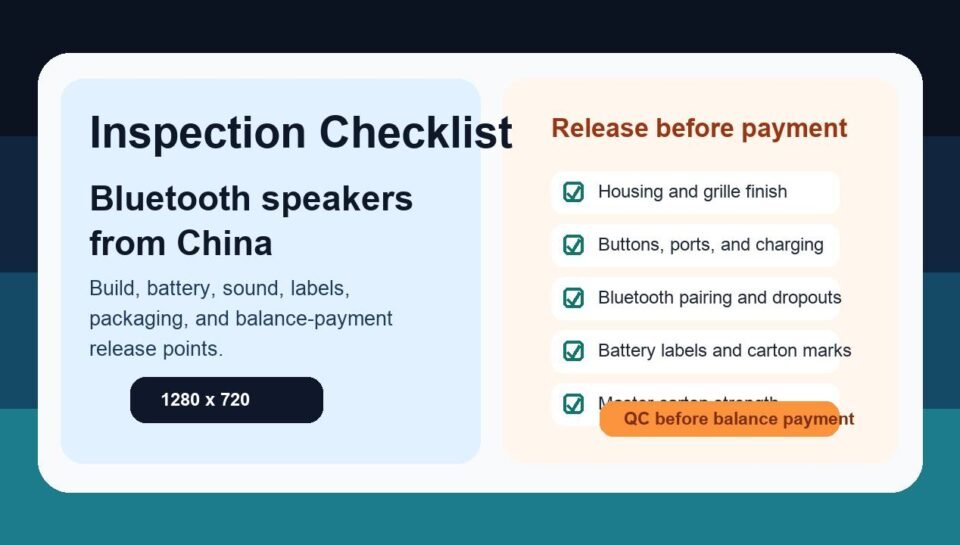
| Inspection area | What to verify | Why it matters before payment |
|---|---|---|
| Appearance and build | Housing finish, grille alignment, logo position, seams, screws, buttons, ports | Cosmetic defects and weak assembly create returns fast on audio products |
| Function and sound | Pairing, reconnection, playback, distortion, charging, button response, port stability | A speaker that powers on is not enough if sound or charging fails in use |
| Battery and safety labels | Capacity mark, warning labels, carton battery marks, accessory match | Wrong battery details cause customs and marketplace problems |
| Packaging and cartons | Inner protection, drop resistance, barcode accuracy, carton condition, pallet logic | Weak packaging damages the product after the factory, not during the sample review |
| Compliance documents | Exact model match for CE, FCC, RoHS, and any battery paperwork claimed | Old reports for another model do not protect your shipment |
1. Housing, finish, and assembly checks
Start with the visible build. Bluetooth speakers sell on first impression, so scratched housings, fabric wrinkles, sharp mold lines, uneven color, or crooked logos are not minor details if you are selling retail or online. But do not stop at the outer shell. Check the feel of buttons, the firmness of rubber feet, the fit around charging ports, and whether any screws or grilles are loose.
- Compare color, texture, and logo position with the approved sample.
- Check seams, glue lines, mesh, passive radiator trim, and port cutouts.
- Press every button and confirm the tactile feel is consistent.
- Test USB or charging-port fit with the actual cable packed in the box.
- Shake a few units lightly to catch loose internal parts or screws.
2. Functional and audio checks
This is where quick inspections often become too light. Buyers listen to one track, hear sound, and move on. That misses the failures customers actually report. I would test pairing speed, reconnection after power cycling, playback stability, speaker distortion at low and high volume, microphone pickup if the speaker supports calls, and charging behavior during use.
On a new supplier, test more than one unit from different cartons. A single hero sample can hide batch inconsistency. For stereo-pair or TWS speaker functions, verify the pairing flow and confirm the feature still works after reset.
- Pair the speaker with at least two phones if possible.
- Check Bluetooth reconnection after the speaker is switched off and on again.
- Run playback at low, medium, and high volume to catch distortion or rattling.
- Confirm charging indicator behavior and basic playback while charging if the product claims it.
- Verify any app control, call function, RGB light mode, or waterproof claim that appears on the packaging.
3. Battery, charging, and accessories
Battery issues are expensive because they create customer complaints, shipping trouble, and safety questions at the same time. Inspectors should compare the battery information on the unit, packaging, manual, and carton marks. If those details do not match, stop and clarify before release.
I also check whether the packed cable is the right type and length, whether the plug fits cleanly, and whether the charging time claimed by the supplier makes sense against the battery size. A nice speaker with the wrong charging cable still turns into a complaint.
- Check battery capacity markings on the unit and manual where applicable.
- Confirm the packed charging cable matches the connector on the speaker.
- Look for overheating, charging interruption, or unstable indicators during spot tests.
- Review carton battery marks and any transport paperwork promised by the supplier.
4. Labels, manuals, and compliance file match
A speaker order can look fine on the line and still be risky because of document mismatch. If the supplier promises CE, FCC, RoHS, or battery files, compare the document details with the actual product being shipped. Model number, brand, PCB, power rating, and enclosure configuration should make sense together.
Do not treat a report from a similar model as a clean pass. I have seen suppliers reuse old reports with different batteries or different board layouts. That is exactly the kind of mismatch that appears after the shipment leaves China, when it is harder to fix.
- Match model number and brand name across the unit, gift box, carton, and report set.
- Check warning labels, importer details, and country-specific marks before final release.
- Confirm barcode and SKU mapping if there are multiple colors or versions in one order.
- Ask the supplier to explain any report that covers a different casing, module, or battery setup.
5. Packaging and carton checks
Packaging matters more on Bluetooth speakers than many buyers expect. A unit can leave the factory in good shape and arrive with cracked grilles, crushed corners, or damaged ports because the inner protection was reduced to save cost. For e-commerce shipments, that risk is even higher.
- Open packed units to confirm foam, trays, bags, and inserts match the approved version.
- Check barcode print quality, carton count, carton weight, and sealing condition.
- Inspect master cartons for corner damage, weak board, or poor tape application.
- If the supplier promised a drop-test standard, ask for the record or witness a spot check.
6. Defect grading before you release balance payment
A checklist works better when it is tied to a defect rule. For most speaker orders, I would treat no power, no charge, unstable Bluetooth pairing, major sound distortion, loose ports, missing accessories, wrong labels, and damaged cartons as major failures. Light cosmetic marks may be minor, but that threshold should be agreed before inspection day.
The point is not to create an academic grading system. The point is to avoid the supplier saying a problem is minor after the buyer has already paid. If the release rule is written in advance, the argument is shorter.
What importers should ask the supplier before inspection day
- Which cartons are fully packed and ready for random selection.
- Whether any materials, batteries, or labels were changed after sample approval.
- What test records exist for aging, charging, and waterproof checks if claimed.
- Which compliance documents belong to the exact shipped model.
- How fast rework can be finished if the inspection finds a blocking issue.
If you need local support in China for supplier follow-up, pre-shipment quality inspection, compliance document review, or release decisions before balance payment, Direct Sourcing China can manage that process on the ground.
Related reading: How to Source Bluetooth Speakers from China in 2026, Quality Inspection China, and How to Verify a Chinese Supplier Before Paying a Deposit.
FAQ
Inspect after at least 80 percent of the goods are packed, but before the balance is released. That is the best point to catch assembly, packaging, and labeling problems while the supplier can still rework the shipment.
Battery swelling, charging failure, Bluetooth dropouts, distorted sound, dead buttons, loose ports, wrong labels, and weak packaging should be treated as major risks because they lead to returns or customs problems.
Sometimes they try, but buyers should compare the report with the exact model, PCB, battery, enclosure, and brand details. A report for a similar speaker is not enough if your shipped product is different.
Yes. The sample proves what you want to buy. The pre-shipment inspection checks whether mass production still matches that approved sample after assembly, packaging, and labeling are finished.
Yes. Bluetooth speakers often fail in transit because the unit box or master carton is too weak. Carton condition, inner protection, pallet layout, and drop resistance should be part of the release decision.