

Bluetooth Audio Products from China: CE, FCC, RoHS and Battery Documents

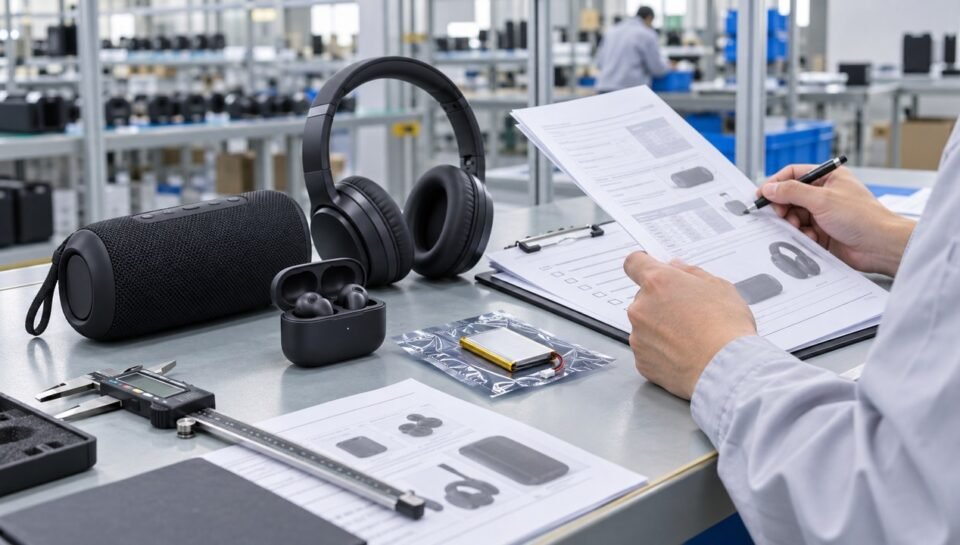
A Bluetooth speaker, pair of earbuds or wireless headset can pass a sound check and still be unfit for import. The radio grant may cover a different module, the CE declaration may name another model, the RoHS report may be limited to a housing sample, or the lithium battery file may not match the cell used in production. These gaps tend to appear late, when packaging is printed and the balance payment is due.
Importers can prevent most of those problems by treating compliance documents as controlled product data. The model number, printed circuit board, Bluetooth module, antenna, firmware, battery cell, charging input, power adapter, labels and manual should all point to the same approved configuration. The exact requirements depend on the destination market and product features, so the first step is to define the market and model list before asking a factory for certificates.
Start with a market and model matrix
Do not send suppliers a broad request for CE, FCC and RoHS certificates. Build a one-page matrix for every sales model, including color or packaging variants where they affect labels or accessories. Record the destination, radio functions, battery type, charging method, included adapter, app or cloud connection, microphones, children’s use claims and intended user environment.
| Product detail | Why it changes the document check |
|---|---|
| Bluetooth version, module and antenna | Links the radio test evidence and grant to the production hardware |
| Earbud, headset or portable-speaker format | Affects safety, RF exposure, charging and EU common-charger analysis |
| Cell model and pack configuration | Controls battery safety evidence and UN 38.3 transport classification |
| USB-C input and charging power | Affects charging specifications, labeling and the EU common-charger file |
| App, account or internet connection | Can add privacy, software and cybersecurity requirements |
| Sales country and importer identity | Determines the responsible party, language, registration and market labels |
This matrix becomes the index for the technical file. It also helps a compliance laboratory quote the correct scope. A factory certificate folder without this product map is hard to audit because similar-looking audio products often share housings while using different boards, cells and radio modules.
CE documents for Bluetooth audio sold in the EU
Bluetooth audio equipment is radio equipment. The EU Radio Equipment Directive sets essential requirements for safety and health, electromagnetic compatibility and efficient use of radio spectrum. The CE mark is the visible result of a conformity process; it is not a testing service that a supplier buys once for any product using the same shell.
Ask for the complete EU file
- EU Declaration of Conformity naming the legal manufacturer and exact model or controlled model family.
- A standards list and test reports for the applicable safety, EMC, radio spectrum and RF exposure requirements.
- Technical documentation with product description, drawings, schematics, critical BOM, risk assessment, photos, labels, manuals and software or firmware identification.
- Evidence for the conformity-assessment route, including notified-body documents if that route was required or chosen.
- EU economic-operator details, traceability marking, destination-language instructions and required warnings.
Read the reports beyond the first page. Compare applicant, manufacturer, model, module, antenna, operating frequencies, power supply and internal photos with the sample. A report for a mono speaker with one driver does not automatically cover a stereo model with a larger amplifier and a different battery. For true wireless earbuds, check the earbuds and charging case as a system, including every radio and charging mode.
EU requirements that audio buyers should check in 2026
Rechargeable headphones, headsets, earbuds and portable speakers that use wired charging have been within the EU common-charger rules since 28 December 2024. The European Commission’s common charging guidance covers the USB-C receptacle, charging technology, consumer information and the option to buy the device without a bundled charger. Buyers should review the device, packaging artwork and manual together. A USB-C-shaped socket alone does not prove that the charging requirements have been met.
Connected products also need a current cybersecurity applicability check. The RED cybersecurity requirements in Delegated Regulation (EU) 2022/30 apply to covered products placed on the market from 1 August 2025 through 10 December 2027. Delegated Regulation (EU) 2026/339 repeals that act from 11 December 2027, when the main Cyber Resilience Act obligations take over. The scope depends on functions such as internet connectivity, personal-data processing and payment or fraud risk. A basic Bluetooth-only speaker and an app-connected headset may therefore need different analyses. Record the conclusion instead of assuming every Bluetooth product has the same cybersecurity file.
FCC documents for the United States
Bluetooth transmitters are intentional radiators and generally require FCC certification before marketing or import into the United States. Request the FCC ID and search it in the FCC Equipment Authorization System. Match the grantee, product code, equipment class, frequency range, output power, test photos, internal photos, antenna and grant notes to the product being ordered.
A certified Bluetooth module can reduce part of the radio approval work, but it does not give the host product unlimited coverage. The factory must follow the module’s grant conditions and integration instructions. Antenna changes, co-located radios, host shielding, enclosure layout and RF exposure conditions can require evaluation or additional authorization. The FCC’s KDB 996369 module guidance gives the current framework for modular approvals and host integration.
- FCC grant of equipment authorization for the exact FCC ID.
- Test report, setup photos, external and internal photos, block diagram, schematics and operational description.
- Module integration instructions and a written host-product assessment when a certified module is used.
- RF exposure evaluation appropriate to how close the product is used to the body or head.
- Final FCC ID label or e-label, user-manual statements and US responsible-party information where applicable.
Headphones and earbuds deserve careful RF exposure review because they are used close to the head. A portable speaker may be assessed under different use-distance assumptions. Do not let the supplier reuse one compliance statement across products with different operating positions.
RoHS evidence should follow the BOM
The EU RoHS Directive currently restricts ten substances in electrical and electronic equipment. A single XRF screening report on the finished housing gives limited evidence. It may not reach solder, connector plating, cable insulation, adhesives, pigments or internal components.
Build the RoHS file from the production BOM. Ask for material declarations and laboratory evidence linked to supplier part numbers for the cell, PCB, solder, cables, connectors, plastics, coatings, speaker drivers and accessories. Record any exemption and the component where it is used. The purchase order should require approval before the factory changes a material or sub-supplier.
Pay attention to late-added accessories. A compliant speaker can ship with a non-compliant USB cable or adapter if purchasing teams treat accessories as packaging items. Add every included item to the RoHS and change-control list.
Battery documents for earbuds, headphones and speakers
Battery paperwork serves several purposes, so one document cannot replace the rest. Product safety evidence, EU market documentation and dangerous-goods transport documents answer different questions. Ask the cell maker and finished-product factory to identify the cell model, chemistry, nominal voltage, rated capacity, watt-hours, protection circuit and pack configuration.
- Cell and battery specifications linked to the approved BOM and production sample.
- Safety test evidence appropriate to the product and destination, often including IEC 62133-2 for portable rechargeable cells and batteries when required by the compliance plan or customer.
- A UN 38.3 test summary for the exact cell or battery type. The manufacturer and subsequent distributor must be able to make this summary available.
- A current safety data sheet when requested by the carrier or logistics provider. An SDS is useful handling information but is not a substitute for the UN 38.3 test summary.
- Shipment classification, watt-hour calculation, packing method, marks, labels and shipper documents confirmed for batteries contained in equipment or packed with equipment.
- EU battery technical documentation, declaration, CE marking, labels and importer details for the phase-in requirements that apply to the battery and placing-on-market date.
IATA explains that lithium battery manufacturers and subsequent distributors must make the UN 38.3 test summary available, including for batteries installed in equipment. Its lithium battery shipping guidance also notes that states and operators can impose stricter conditions. Confirm the shipment with the freight forwarder before production ends because air, sea and courier routes may need different packaging and booking data.
For the EU, Regulation (EU) 2023/1542 applies to batteries whether sold alone or incorporated into products. The EU Batteries Regulation introduces phased safety, sustainability, conformity, labeling and information duties. Ask the responsible compliance specialist to map the obligations to the battery category and placing-on-market date. This is safer than copying a generic battery label from another product.
How to compare a supplier’s document pack
| Checkpoint | Acceptable evidence | Common warning sign |
|---|---|---|
| Model identity | Same model or controlled family across reports, labels, manual and sample | A certificate lists a similar model with no family rationale |
| Radio hardware | Module, antenna, PCB and firmware match report exhibits | Internal photos show another board or antenna |
| Battery | Cell code, capacity and pack match the UN 38.3 summary and BOM | Supplier provides a summary for an unnamed generic cell |
| RoHS | Evidence linked to high-risk parts and supplier part numbers | Only a finished-housing XRF page is available |
| Market artwork | Approved product, package and manual files for the sales country | Marks are added after production with no artwork review |
Create a gap list with an owner and due date before paying the deposit. If the supplier says a report will arrive before shipment, ask who has booked the laboratory, which samples will be tested and what happens if the product fails. Compliance work started after mass production often becomes a negotiation over rework rather than a controlled approval process.
Lock the approved sample and control production changes
Mark the golden sample with a unique ID and record its external appearance, PCB revision, radio module, antenna, firmware, cell code, charging case board, adapter and accessories. Keep photographs of internal parts that an inspector can compare without specialized laboratory equipment.
The purchase order should require written approval for changes to the cell, PCB, radio module, antenna, amplifier, charging IC, plastics, cable, adapter, firmware and sub-suppliers. A component substitution can affect safety, EMC, radio, RoHS or battery shipping evidence even when the product still plays music. Ask the laboratory or regulatory adviser whether the change needs engineering review, partial testing or a new authorization.
Add document checks to pre-shipment inspection
A pre-shipment inspection cannot recreate CE or FCC laboratory tests. It can confirm that the inspected goods still match the approved configuration and market artwork. Give the inspector the golden sample, current labels, packaging files, manual, BOM checkpoints and a model-by-model checklist.
- Check product, case, package and carton model numbers and traceability codes.
- Compare visible PCB, Bluetooth module, antenna, cell and charging components on selected units with approved photographs.
- Verify CE and FCC markings, FCC ID, battery information, importer details, warnings and required languages.
- Confirm charger, cable, ear tips, manual and other accessories against the approved pack list.
- Run pairing, audio, microphone, charging, button, indicator, battery-runtime and basic heat checks under the inspection plan.
- Photograph labels and internal components for sampled units, then record batch or serial references.
For product-level inspection methods, use our Bluetooth speaker quality inspection checklist. The wider CE, FCC and RoHS guide for electronics importers explains how to review declarations, grants and technical files across other electronic categories.
How Direct Sourcing China can support the order
Direct Sourcing China can coordinate supplier screening, RFQ comparison, sample follow-up, document matching, change control and pre-shipment inspection for Bluetooth speakers, earbuds and headphones. We do not replace a qualified laboratory or legal adviser. Our role is to keep the factory, buyer, product sample and compliance evidence on the same revision, then escalate technical gaps to the right specialist before production or payment.
If you are preparing a Bluetooth audio order, send us the target market, product specification and current supplier document list. We can help separate missing factory evidence from work that needs a laboratory, responsible party or regulatory adviser.
Frequently asked questions
No. Review the applicable legislation, EU Declaration of Conformity, technical documentation, test evidence, labels, instructions and economic-operator information for the exact model. A certificate cover page alone does not establish conformity.
Only when the module grant conditions and integration instructions are followed. The host, antenna, co-located radios, RF exposure and labeling still need review, and changes can require additional testing or authorization.
No. RoHS evidence should cover the production BOM and high-risk materials such as solder, cables, connectors, plating, pigments, adhesives, batteries and included accessories.
No. A safety data sheet provides handling and hazard information. A UN 38.3 test summary identifies the tested cell or battery type and the required transport test information. Carriers may ask for both.
Inspection can compare production goods, labels and selected components with approved records. It cannot replace laboratory testing or the legal conformity and authorization process.