




Product Development in China: How Importers Can Turn an Idea into a Manufactured Product

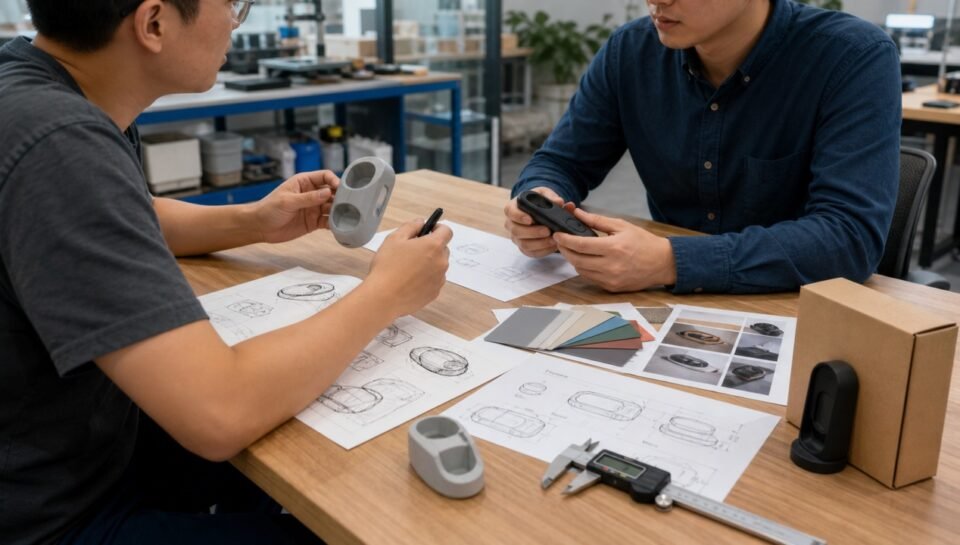
A new product can go wrong long before the factory starts mass production. The first quotation may be based on a rough sketch. A prototype may look right but hide weak clips, the wrong plastic or an expensive assembly step. By the time these gaps appear in a tooling sample, the buyer has already spent money and lost weeks.
Product development in China works best when the importer treats each sample as a decision point. The goal is to turn an idea into a controlled specification that a factory can repeat, inspect and ship. This guide covers the commercial and manufacturing work between the first brief and the first production order, including supplier selection, prototypes, tooling, quality, payment and compliance.
Start with a product brief that a supplier can price
A supplier cannot quote an idea accurately. It needs a defined use, target customer, expected order quantity, selling market, required features and a target cost. A sketch helps, but the written brief should explain what the product must do and which details are still open for engineering advice.
Separate required features from preferences. If waterproofing, load capacity, battery life or a particular dimension affects customer safety or the sales claim, state the requirement and the test that will prove it. Color, surface texture or packaging style may allow more options. This distinction lets the supplier propose changes without quietly weakening the product.
- Intended user, use environment and expected service life
- Target market, sales channel and planned retail price
- Core functions with measurable performance requirements
- Size, weight, materials, finish, colors and branding
- Estimated first order, annual volume and target factory cost
- Packaging, labeling, accessories and delivery deadline
- Known safety, testing or certification requirements
Do not hide the target cost. A factory that understands the commercial limit can suggest a different process, stock component or assembly method. Without that number, teams may spend a month refining a design that will never reach the required margin.
Choose a development route before choosing a supplier
There are three common routes. The first is private labeling an existing factory model. The second is modifying a proven platform with a new housing, feature, material or package. The third is developing a product around a new structure or function. These routes need different budgets and controls. Private label work is faster because most engineering decisions already exist. A new structure needs drawings, prototypes, design reviews and often custom tooling.
For many importers, a modified platform is the sensible first step. Existing internal components or a proven manufacturing process reduce uncertainty, while visible changes create a distinct product. Ask the supplier to identify every part that stays standard and every part that becomes custom. That list affects minimum order quantity, spare parts, tooling ownership and the ease of moving production later.
Find a supplier whose process fits the product
A factory can be reliable and still be wrong for the project. A supplier that makes simple injection-molded housings may lack electronics integration, precision assembly or packaging engineering. A polished showroom also says little about how the business handles drawing revisions and failed samples.
Ask prospective suppliers to explain how a similar product moved from drawing to production. Review the equipment at the quoted address, the engineering team, sample records, quality procedures and subcontracted work. For a multi-part product, map who makes the housing, PCB, cable, metal parts, packaging and tooling. The lead supplier should have a clear incoming-control method for components it does not make.
- Which engineering and manufacturing steps happen at this address?
- Who prepares CAD files, drawings, bills of materials and test instructions?
- Which parts and processes are subcontracted, and to whom?
- How are revisions issued to production and old files withdrawn?
- Can the supplier show a controlled sample and pilot-run record?
- Who investigates a failure and approves corrective work?
Verify the legal company and bank beneficiary before paying a development deposit. Our guide on checking a Chinese supplier before payment covers the company-side review that belongs next to the technical assessment.
Use prototypes to answer one set of questions at a time
A prototype is useful only when the team agrees on what it must prove. An appearance model can confirm size, grip and visual proportions. It may be unsuitable for drop tests or heat testing. An engineering prototype can prove fit and function but use a rough finish. A tooling sample checks the actual production process. Calling all of these a sample creates avoidable arguments.
- Review the concept for user needs, dimensions and cost risk.
- Build an appearance or rapid prototype to settle form and basic ergonomics.
- Build a functional prototype to test the structure, components and performance.
- Review tooling samples made with intended materials and production processes.
- Run a small pilot batch to check assembly, test time, packaging and repeatability.
- Release mass production only after the final sample and documents are approved.
Keep a revision log. Each version should have a date, identifier, change description, reason and approval. Photos in a chat thread are hard to audit once drawings, parts and packaging have changed several times. One current document set should point to the approved CAD file, drawing, bill of materials, color standard, artwork and test plan.
Design for the real factory process
A shape that works in a 3D print may be slow, fragile or impossible to mold. A tight cosmetic gap may require extra fixtures and manual adjustment. A beautiful package may be difficult to assemble without scratches. These are manufacturing problems, so bring production engineers into the review before the design is frozen.
Ask the factory to mark critical dimensions, likely tolerance problems, draft angles, wall thickness transitions, fastening points and assembly access. For electronics, review connector access, heat, antenna space, wire routing, firmware loading and end-of-line testing. For sewn goods, review seam allowance, material stretch and how a pattern will be graded across sizes. Every product has its own process limits.
The review should also examine how defects will be found. If a sealed product can be tested only after final assembly, one hidden problem may create a large rework bill. Moving a functional check earlier in the line can make a design easier to manufacture and easier to control.
Control drawings, the bill of materials and substitutions
The approved sample is important, but it cannot describe everything inside the product. A bill of materials should identify major parts, material grades, supplier part numbers and approved alternatives. Drawings should give dimensions, tolerances, finishes and inspection points. Product artwork needs its own version and color references.
State that material or component substitutions need written approval before use. A supplier may face a component shortage or a resin price increase and believe an alternative is equivalent. The change may affect appearance, life, compatibility or compliance. Ask for the reason, technical comparison, updated documents and a sample or test result before deciding.
Put tooling ownership and maintenance in writing
Custom molds, dies, fixtures, gauges and test jigs can cost more than the first product order. The agreement should name the owner, payment milestones, storage location, tool number, expected life, maintenance responsibility and rules for use. Photograph the tool identification after acceptance and keep the final tool drawing where the contract allows.
Do not approve a mold because one sample looks good. Check a representative set from a stable run and measure critical cavities or positions. Record any permitted rework. If the buyer later moves production, the agreement should explain access to paid-for tooling and related files. Local enforcement and transfer can still be difficult, which is why supplier selection and clear records matter from the start.
Build compliance into the design review
Destination requirements can change the construction, materials, warnings, traceability and documents. Identify the product category and sales markets before ordering tooling. A report for a similar factory model may not cover a new enclosure, battery, coating, adapter or intended user. Ask which exact sample and bill of materials the report represents.
For products sold in the EU, the General Product Safety Regulation requires safety analysis and technical documentation for consumer products within its scope, alongside any product-specific rules. In the United States, the CPSC explains testing and certification for regulated general-use products. The responsible importer should confirm the applicable rules for the finished product and keep evidence tied to the production version.
Plan final testing around a production-representative sample. It should use the intended materials, components, firmware, labels, warnings, instructions and accessories. If a later material change affects a tested characteristic, review whether testing or documentation must be updated before shipping.
Negotiate development payments by deliverable
Development fees, prototypes and tooling should have named deliverables. A single large payment described as an engineering charge gives the buyer little control if work stalls. Break the project into practical approvals, such as concept review, functional prototype, final drawings, tooling completion, accepted tooling samples and pilot production.
The purchase agreement should also cover what happens after a failed sample. Decide which corrections are included, when a new fee applies and whether delays change the production schedule. For the first mass-production order, connect the balance payment to an acceptable inspection and the required shipping documents.
Set the quality plan before the first production order
Quality control should begin while the product is being designed. Mark the features that affect safety, function, fit, appearance and packaging. Give each one a test method, sample size or inspection frequency, tolerance and defect classification. The factory can then estimate test time and build the checks into production.
- Incoming checks for materials and purchased components
- First-piece approval after tooling, setup or material changes
- In-process tests at stages where repair is still practical
- End-of-line function tests and records for critical results
- Pilot-run review of yield, cycle time, rework and packaging
- Pre-shipment inspection against the approved sample and documents
Inspect the first commercial order when production is complete and packed, with enough time left for correction. The pre-shipment inspection guide explains how to define the check and use the result before releasing the balance.
Watch the numbers that make or break the project
Unit price is one number. Development fees, tooling, test samples, laboratory work, packaging setup, fixtures, inspection, rejected parts and freight for revisions all belong in the project budget. Calculate the landed cost at realistic order volumes, then test what happens if the first order is smaller or a custom component has a higher minimum.
Ask for a cost breakdown when possible. It helps the team see whether a requested improvement adds a few cents or changes the entire process. It also exposes dependencies. A low product MOQ may still require a large purchase of custom packaging, resin color, chips or printed components.
How Direct Sourcing China can support a development project
Product development needs steady follow-up between the importer and several China-side teams. Direct Sourcing China can help turn the brief into a supplier comparison, coordinate sample revisions, check factory capabilities, follow tooling and pilot production, and arrange product-specific quality inspection before shipment.
Send the product concept, intended market, target quantity, budget range and current drawings or sample. Direct Sourcing China can map the next steps across sourcing, product development, quality inspection and compliance support, then identify the decisions the importer should close before money moves.
FAQ
A simple modification to an existing product may take several weeks. A new product with engineering work, custom tooling, testing and packaging often takes several months. The useful schedule is built around specific approvals, such as the design brief, prototype, tooling sample, pilot run and production release, rather than one supplier promise.
Either can work. A factory may offer stronger process control for products that match its equipment, while a capable trading or development company may coordinate several specialist suppliers. Verify who owns the engineering work, who makes each component and who is responsible when a sample fails.
The development agreement and purchase order should state who owns paid-for drawings, CAD files, molds, fixtures, test software and other project assets. Record where tooling is stored, how it is identified, who may use it and what happens if production moves to another supplier.
Identify destination-market requirements before the design is frozen. Early component and material checks can prevent an expensive redesign. Final testing should use a production-representative sample with the materials, electronics, labels, instructions and packaging intended for sale.
Yes. Direct Sourcing China can help prepare supplier comparisons, coordinate prototypes, track revisions, review production readiness, arrange quality inspections and follow up on packaging, compliance documents and shipment handoff in China.






1 Comment
OEM vs ODM Manufacturing in China: Which Is Better for Your Product? - Professional in Auido Products | Best China Sourcing Agent of Best
October 1, 2026[…] a broader stage-by-stage workflow, read our guide to product development in China. It covers briefs, prototypes, tooling samples, pilot production and the release to mass […]