
How to Source Wireless Chargers from China in 2026: Compatibility, Safety and MOQ Guide

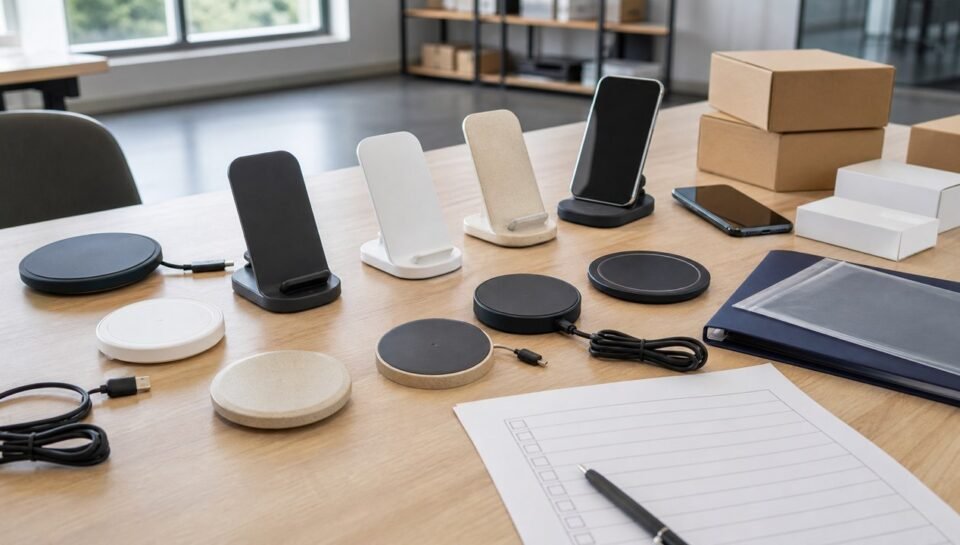
Wireless chargers look simple from the outside: a pad, a stand, a cable, maybe a magnetic ring. For importers, the real work is behind the quote. You need to check phone compatibility, charging speed, heat control, certification, packaging, MOQ and shipping rules before paying a deposit.
This is especially important in 2026. Many suppliers still sell older 5W and 10W models, while buyers are asking for 15W charging, magnetic alignment, Qi2 and newer premium options. A product listing that says “fast wireless charger” is not enough. The sample, documents and factory control need to match the claim.
For Direct Sourcing China, wireless chargers sit in the same risk category as other small electronics: not impossible to source, but easy to buy badly if the buyer only compares unit price.
Start with compatibility, not the shape
The first question is not whether the charger looks modern. The first question is what devices the end users actually use. A flat charging pad may be fine for a desk accessory. A magnetic stand may fit newer phones better. A foldable 3-in-1 charger may look attractive, but it adds more parts, more testing points and more packaging risk.
Basic Qi-compatible wireless chargers are still common. Many models support 5W, 7.5W, 10W or 15W output depending on the phone, input adapter, cable and charger design. According to the Wireless Power Consortium, Qi2 adds magnetic alignment and supports 15W wireless charging for certified compatible products.
- 5W or 10W chargers may be enough for budget desk use.
- 15W Qi-compatible models are better for mid-range orders, but the adapter and cable still matter.
- Qi2 magnetic chargers make more sense when the target users have compatible phones.
- Multi-device chargers need extra testing because phone, earbud and watch charging areas may perform differently.
Qi, Qi2 and higher-power claims
Qi is the long-running wireless charging standard used by many smartphones and accessories. The Wireless Power Consortium says certified products can be checked through its official product database. If a supplier claims Qi or Qi2 certification, ask for the product ID and verify it yourself.
Qi2 matters because alignment is one of the common user complaints with wireless charging. If the phone is slightly off-center, charging may slow down or stop. Magnetic alignment reduces that problem when the phone and charger support it. Still, real charging speed depends on the phone, adapter, cable, firmware and temperature control.
Do not approve a model only because the supplier writes 15W, Qi2 or fast charging on the quotation. Ask for the actual input specs, output specs, certification status, test report, user manual and recommended adapter.
Certification is where cheap chargers become risky
Wireless chargers handle power and heat near a phone. That puts them in a different risk category from simple plastic products. A weak charger can overheat, charge slowly, fail early or create customer complaints after shipment.
For the U.S. market, importers should check whether FCC-related requirements apply. The FCC explains equipment authorization for radiofrequency devices on its official equipment authorization page. For Europe, buyers normally check CE marking and RoHS requirements through sources such as the European Commission pages for CE marking and the RoHS Directive.
The exact documents depend on the product, destination market and sales channel. Some buyers may also request UL, ETL, UKCA, REACH, Prop 65 or battery-related documents. If the supplier cannot explain what documents are available, slow the order down.
Sample testing: heat, alignment and real charging behavior
Heat is one of the main quality issues with wireless chargers. Some warmth is normal during wireless charging. Excessive heat is not. Sample testing should use the same cable, adapter and phone types that the buyer expects end users to use.
- Check whether charging starts easily without careful repositioning.
- Test several iPhone and Android models instead of one phone only.
- Run charging long enough to see heat behavior, not just the first minute.
- Check foreign object detection with a safe controlled test method.
- Confirm cable fit, LED behavior, anti-slip pads, manual, labels and packaging.
- Compare mass production against the approved golden sample before balance payment.
For multi-device chargers, test each charging position separately and together. A sample can charge one phone well but perform poorly when the phone, earbuds and watch area are used at the same time.
Branding and packaging need early review
Wireless chargers are usually customized by pad printing, UV printing, laser engraving, full-color digital print, light-up logo or custom packaging. The best method depends on the surface material and the logo position.
ABS plastic is common for lower-cost models. Aluminum looks more premium and often supports laser engraving. Bamboo or recycled-material shells can fit eco-themed orders, but textured surfaces need print testing. A round pad may look like it has a large top area, yet the coil area, LED window, anti-slip ring or magnetic ring can reduce the useful logo space.
Packaging should not be left until the last week. A good inner tray, clear user manual, correct input/output label and strong export carton can prevent returns and reduce support questions after delivery.
MOQ and cost: what changes the quote?
MOQ depends on whether the order uses a stock model or a custom mold, whether the color is standard, whether packaging is customized and whether the buyer needs complete compliance documents. Stock models with a simple logo usually start lower. Custom color, light-up logo, retail box, private label work or a newer Qi2 model usually pushes MOQ and lead time higher.
- Power level: 10W, 15W, Qi2 or higher-power certified models.
- Material: ABS, aluminum, bamboo, recycled plastic or mixed material.
- Logo method: print, engraving, light-up logo or full-color print.
- Cable: USB-A to USB-C, USB-C to USB-C, cable length and cable quality.
- Packaging: bulk pack, gift box, sleeve, manual and carton requirements.
- Certification: existing documents versus new testing requirements.
- Inspection: basic visual check versus charging, heat and packing tests.
When comparing quotes, ask whether the price includes the cable, packaging, setup cost, sample cost, logo proof, carton markings and export documents. A cheap quote may exclude the cable or include a poor cable that limits charging performance.
Shipping: charger pad or power bank?
A standard wireless charging pad or stand normally has no internal battery. It is an electronic accessory powered by cable. Shipping is usually simpler, though it still needs proper packing and customs declaration.
A wireless charging power bank is different. If the product has a built-in lithium battery, battery shipping rules apply. That may involve UN38.3 evidence, watt-hour information, UN3480 or UN3481 classification, lithium battery marks and carrier approval. IATA publishes lithium battery and dangerous goods guidance on its lithium batteries page, but the final shipping route should always be checked with the freight forwarder before production is rushed.
How Direct Sourcing China helps with wireless charger sourcing
Direct Sourcing China can help importers compare supplier types, check whether the quotation matches the specification, review samples, confirm certification documents, follow production and arrange pre-shipment inspection. For electronics, the useful work is often in the small details: cable quality, charging start, heat behavior, carton strength, labeling and whether the factory can repeat the approved sample in mass production.
This sourcing method also applies to related categories such as Bluetooth speakers, earbuds, car audio products and other electronic accessories. If you are buying wireless chargers mainly as corporate gifts, this related article from our partner site may also help: Promotional Wireless Chargers 2026: Compatibility, Safety and MOQ.
For sourcing support, sample checks, supplier follow-up or pre-shipment inspection in China, you can review our Direct Sourcing China services or contact us before placing a deposit.
FAQ
No. They work only with devices that support wireless charging. Charging speed depends on the phone model, charger standard, adapter, cable, coil alignment and heat control.
For serious retail, distributor or corporate orders, yes. Ask for the WPC product ID and check it in the official Qi Certified Product Database instead of relying on a supplier presentation.
Common requests include Qi or Qi2 certification, FCC for the U.S. market, CE and RoHS for Europe, and sometimes UL, ETL, UKCA, REACH or Prop 65 depending on product type and sales channel.
A normal charging pad or stand usually has no internal battery. A wireless charging power bank does, so UN38.3 evidence, watt-hour information, UN3480 or UN3481 classification and carrier approval may apply.
MOQ depends on the model and customization. Stock models with one-color logo printing can start lower. Custom color, custom packaging, Qi2 models, light-up logos or private label work usually require a higher MOQ.