

How to Source Yangjiang Knives and Scissors from China: Supplier and Quality Guide

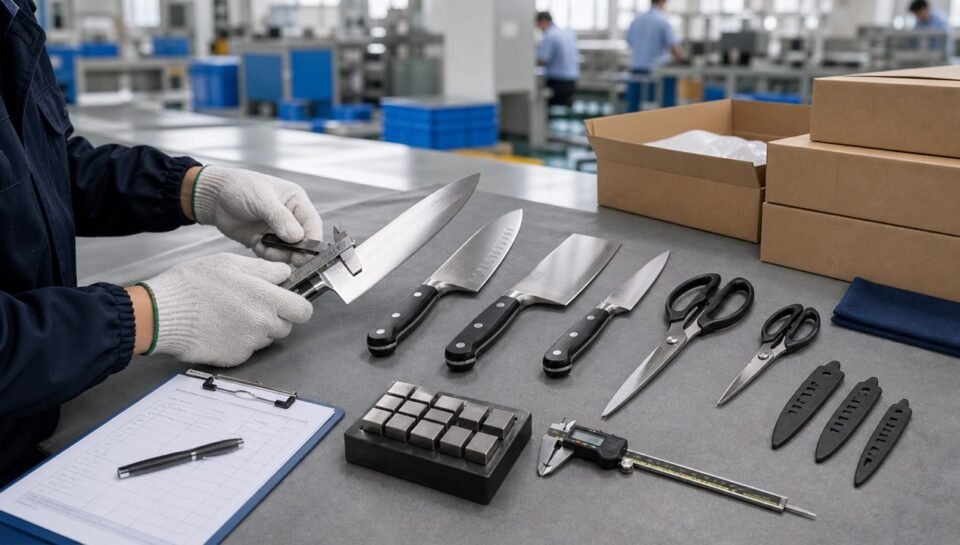
A Yangjiang supplier can show you a polished knife sample within days. The harder question is whether the same factory can hold the steel, heat treatment, edge, handle fit and packaging standard across a full production run. Those details decide whether the order arrives ready to sell or turns into a sorting job at your warehouse.
This guide is for importers buying kitchen knives, household scissors, tailor’s shears and other manual cutting tools from China. It covers supplier selection, product specifications, samples, quality control, payment and destination-market checks. It does not replace product-specific legal advice; knife restrictions and labeling rules differ by market and by intended use.
Start with the exact product, not a supplier catalogue
Send a short product brief before asking for prices. A chef’s knife, poultry shears and school scissors have different users, failure modes and inspection methods. If the request is only “8-inch stainless knife with black handle,” suppliers will fill in the missing details themselves. Their assumptions may not match yours.
Define where the product will be sold, who will use it and how it will be packed. State whether the order is an existing supplier model with your logo, a modified platform or a fully custom item. That choice affects tooling, minimum order quantity, sample time and the evidence you should request.
- Product type and intended task, such as slicing, boning, household cutting or textile work
- Sales market, user group and any age-related positioning
- Target retail price, order quantity and expected reorder volume
- Private-label changes, custom tooling and packaging format
- Required delivery date and shipping method
What to put in a knife specification sheet
Steel names alone do not make a usable specification. A grade must be paired with an agreed hardness range, blade dimensions, heat-treatment result and performance test. Ask the supplier to identify the exact steel designation and its source. If material identity matters to your claim or price point, reserve the right to check it through a third-party laboratory.
For the blade, record overall length, blade length, thickness at specified measurement points, width, profile, grind, edge angle or supplier-controlled edge geometry, surface finish and acceptable cosmetic limit. Add a drawing for tip shape, logo position and any critical radius. For handles, specify material, color standard, tang construction, rivets or fasteners, gaps, step limits, odor and resistance to normal cleaning conditions.
Hardness should be measured with an agreed method and at an agreed location. One high reading on a sample does not prove the batch is consistent. Your inspection plan can spread measurements across cartons and production batches, then compare results with cutting performance and edge condition.
What to put in a scissors specification sheet
Scissors need their own checklist. Define blade length, overall length, steel, blade thickness, bevel, tip shape, pivot design, screw or rivet setting, handle material and whether the model is right-handed, left-handed or ambidextrous. State the intended cutting medium. A pair that cuts office paper cleanly may perform poorly on fabric, cardboard or food.
Agree how pivot tension will be judged. The blades should travel smoothly without looseness, excessive force or contact that damages the edge. The supplier also needs a method for checking blade alignment, closing action, tip match and cut consistency. Write the test into the purchase order instead of accepting “normal quality” as a standard.
Verify the supplier’s real production role
Yangjiang’s cutlery supply chain includes factories, specialist processors and trading companies. A capable trading company may manage an order well, but the buyer should know who controls the work. Ask for the Chinese business licence, factory address, equipment list, recent production records and a process flow for your item. Compare those answers during a video call or on-site visit.
Pay close attention to subcontracted steps. A factory may stamp and grind blades but send heat treatment, coating, plastic injection, laser marking or packaging elsewhere. Subcontracting is common; the risk comes from undisclosed processors, weak incoming checks and mixed batches. Ask who approves each outside processor and how nonconforming work is isolated.
- Which steps are completed at the quoted factory address?
- Where are steel, handle components and packaging purchased?
- How are heat-treatment lots identified and recorded?
- Who checks subcontracted coating, marking or injection work?
- Can finished goods be traced to a production date or batch?
- What happens to rejected blades and reworked products?
For the company-side checks that should happen before a deposit, use this Chinese supplier verification guide. A low quotation is not useful if the legal entity, factory and bank beneficiary do not line up.
Use samples to close decisions, not to postpone them
A catalogue sample proves very little if your order changes the steel, handle, finish or packaging. Request a sample that represents the proposed construction, then document every accepted detail. For a custom item, it is sensible to separate the engineering sample from the pre-production sample. The latter should use production materials, tooling, finish, logo and packaging.
Keep one approved sample with the buyer and, where practical, one sealed reference at the factory. Add dated photos and signed specification pages. If a test exposes a problem, revise the specification and ask for a corrected sample. Do not rely on a message saying the factory will “improve it in production.”
- Review dimensions, construction and appearance against the drawing.
- Run the agreed cutting, edge, pivot, corrosion and cleaning checks.
- Approve logo artwork, warnings, barcode and country-of-origin marking.
- Confirm the final bill of materials and any allowed substitute.
- Record the sample version referenced by the purchase order.
Build quality control around the way the product fails
Knife inspection should cover more than scratches. A useful plan checks material evidence, dimensions, hardness, blade straightness, edge condition, cutting performance, tip condition, handle assembly, finish, markings and packaging. Scissors add pivot tension, blade contact, closing action, alignment and a cut test using the specified material.
Choose test methods before production. A vague “sharpness test” invites an argument because hand feel changes from person to person. Define the test medium, number of cuts, sample condition and pass criterion. If laboratory sharpness or edge-retention data supports a product claim, name the test method and laboratory requirement in the order.
Corrosion checks also need context. Stainless steel is not corrosion-proof, and performance changes with grade, heat treatment, finish, cleaning chemicals and exposure. Set a test that reflects the intended product and destination requirements. Check the final decorated product because grinding residue, laser marking and mixed metal contact can change the result.
A practical pre-shipment inspection checklist
- Finished and packed quantity by SKU, size, color and packaging version
- Blade and overall dimensions at the points shown on the approved drawing
- Hardness readings across agreed samples and production batches
- Cut performance, edge burrs, chips, tip damage and blade straightness
- Handle gaps, loose fasteners, cracks, sharp edges and assembly movement
- Scissors pivot tension, blade alignment, closing action and cut consistency
- Surface finish, polishing direction, coating, logo and cosmetic defects
- Retail packaging, protective sleeves, warnings, labels, barcodes and carton marks
Use an agreed sampling plan and defect classification. Safety hazards, a wrong material or a product that cannot perform its stated task should not be hidden inside a broad cosmetic acceptance limit. Add 100% checks for a critical point when sampling does not give enough protection.
Inspection should happen before balance payment, when the order is complete and the factory still has time to sort or rework it. Our pre-shipment inspection guide explains how to connect the report to payment release.
Check destination-market rules before approving packaging
The product name “knife” does not produce one worldwide compliance checklist. Requirements depend on the destination, blade type, intended user, claims, materials and sales channel. Confirm import restrictions and marketplace rules before paying for tooling or printed boxes. A model accepted as kitchenware in one market may face controls elsewhere because of blade design or how it is marketed.
For the EU, the General Product Safety Regulation (EU) 2023/988 applies from 13 December 2024 and sets the general safety framework for consumer products. Importers should review risk assessment, traceability, economic-operator information, warnings, technical documentation and online listing duties that apply to their role. Ordinary manual kitchen knives should not be given a CE mark merely as a sales decoration; CE marking is used only where applicable EU harmonisation legislation requires it.
Kitchen knives and other articles intended to contact food also need a material review. The EU framework under Regulation (EC) No 1935/2004 requires food-contact articles to be sufficiently inert under normal or foreseeable use. Ask for documentation and testing that match the complete product, including coatings, adhesives, handles and decorations where they can contact food.
For the United States, country-of-origin marking should be decided before mass packaging. U.S. Customs and Border Protection explains that foreign-origin articles generally need a legible English country-of-origin mark unless an exception applies. Product safety, food-contact, state and local knife rules may add separate obligations. Ask your customs broker or compliance adviser to confirm the exact product and destination.
If scissors are marketed for children or as toys, do not assume the adult household checklist is enough. Age grading, accessible points, packaging claims and the applicable toy or children’s-product rules need a separate review. The same caution applies to coated blades, antimicrobial claims and products sold for professional food use.
Negotiate MOQ, price and payment against a fixed specification
Quotations are comparable only when suppliers price the same construction. Ask each supplier to state the steel, hardness, finish, handle material, packaging, inspection basis, tooling charge and quantity break. Separate one-time tooling from unit price. Confirm whether the MOQ applies per model, color, logo or packaging version.
Avoid paying a large non-refundable deposit before the supplier, sample and specification are approved. The contract should identify the legal seller, bank beneficiary, product version, delivery term, defect remedy and documents required before final payment. For a first order, keep the balance tied to an acceptable pre-shipment inspection and agreed corrective action.
A price reduction can come from a simpler finish, shared handle tooling, a standard box size or a larger run. Quiet material substitution is not a valid saving. Require written approval before the supplier changes steel, heat treatment, coating, handle resin, fasteners or packaging protection.
Plan packaging and logistics for sharp products
Blade protection is part of product quality and worker safety. Test sleeves, tip guards, inner trays and retail boxes after transport simulation. A knife that moves inside its box can cut packaging, damage its edge or create a hazard for warehouse staff. Scissors should remain closed and secure without excessive ties that frustrate the customer.
Check master-carton strength, gross weight, moisture protection, carton marks and pallet rules with the destination warehouse. Mixed SKUs need clear outer labels and a packing list that matches the physical cartons. If production finishes before the freight booking, arrange secure storage and record carton condition at receipt and release.
How Direct Sourcing China supports knife and scissors orders
Direct Sourcing China can help an importer turn a buying brief into a supplier comparison, a controlled sample and a product-specific inspection checklist. Local follow-up is useful when heat treatment or finishing is subcontracted, when packaging has several revisions, or when the buyer needs an independent check before releasing the balance.
Support can cover supplier sourcing and verification, quotation comparison, sample follow-up, production monitoring, pre-shipment quality inspection, compliance coordination, warehouse and logistics. Send the intended use, destination market, quantity, target delivery date and any current drawing or sample. Those inputs are enough to begin a practical sourcing review.
FAQ
Yangjiang has a dense cutlery supply base covering blade forming, heat treatment, grinding, polishing, handle work, packaging and related trading services. That concentration creates options, but buyers still need to verify which processes a supplier performs and which ones it subcontracts.
Define the intended use, dimensions, steel grade, hardness range, blade geometry, edge requirement, handle material, pivot or assembly details, finish, logo, packaging, labels, test method and approved tolerances. Add photos or drawings where words could be interpreted differently.
Use an agreed, repeatable cutting method with a defined test medium and sample size. The method should match the product's intended use. Record the result together with edge damage, burrs and consistency; a casual hand-feel test is too subjective for acceptance.
Ordinary manual kitchen knives generally do not receive CE marking simply because they are knives. The importer must identify the rules that apply in the destination market, including general product safety, food-contact requirements, traceability, labeling and any local restrictions on particular knife types.
Inspect when production is complete and most or all goods are packed, while there is still time for sorting, rework and re-inspection before shipment. Tie balance payment to an acceptable inspection result and the required shipping documents.