

How to Source Car Audio Products from China: Speakers, Amplifiers, DSP and Head Units

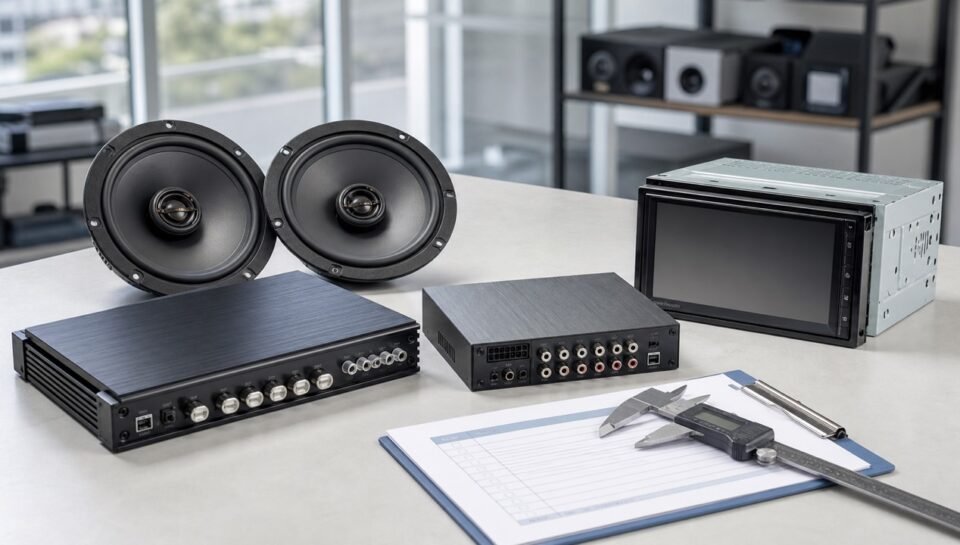
A car speaker, amplifier, DSP and head unit may arrive in one shipment, but they are not one sourcing problem. Each product has different failure points. Speakers depend on materials and assembly consistency. Amplifiers need stable power and thermal control. DSP units live or die by firmware. Head units add displays, radio functions, phone integration and vehicle fitment.
That mix is why a low quotation can become expensive after sampling. Importers need a supplier that understands the exact category, a written specification that can be inspected, and enough time to test the system in a real vehicle before mass production.
Choose the product category before choosing the supplier
The term car audio factory is used loosely. One company may assemble speakers and subwoofers. Another builds amplifier PCBs. A third buys platforms for Android head units and changes the housing, screen and software. A trading company may offer all four, but that does not mean one factory made them.
| Product | Main sourcing risk | What to verify |
|---|---|---|
| Speakers and subwoofers | Material or glue changes alter sound and durability | Driver parts, impedance, sensitivity, power test method and approved acoustic sample |
| Amplifiers | Heat, noise and unstable rated-power claims | PCB version, components, protection circuits, distortion, load test and thermal behavior |
| DSP processors | Firmware bugs and weak tuning support | Input/output channels, sample rate, app compatibility, presets, update method and engineering support |
| Head units | Vehicle fitment and software create many return reasons | Dashboard dimensions, harness, CAN functions, radio region, display, phone functions and firmware policy |
Ask who owns the design, who assembles the product and which work is subcontracted. Then visit or audit the site that controls the risky process. For a head-unit project, a plastic molding workshop is less important than the team controlling the PCB, firmware and final functional test.
Write a specification that can survive production
A supplier cannot hold a stable standard if the purchase order says only 6.5-inch speaker or 4-channel amplifier. The specification should record the approved model, component choices, measurable performance, accessories, labels, packaging and test method. Photos help, but a golden sample and signed specification are stronger.
- For speakers: size, impedance, frequency-response method, sensitivity, rated power, cone and surround materials, magnet, basket finish and polarity marking.
- For amplifiers: channel count, load impedance, supply voltage, rated power test conditions, distortion limit, signal-to-noise requirement, filters, protection behavior and connector layout.
- For DSP: input and output configuration, routing, equalizer bands, crossover options, delay range, control app, supported operating systems and firmware version.
- For head units: screen and chassis dimensions, processor and memory configuration, radio region, Bluetooth and phone-integration functions, harness pinout, camera inputs, steering-wheel controls and supported vehicle list.
Rated power deserves special attention. Suppliers may quote peak, maximum or music power while the buyer expects continuous output under a stated voltage, impedance and distortion limit. Put the test conditions next to the number. Otherwise two attractive quotations may describe very different products.
Screen suppliers with evidence, not product photos
Request a business licence, factory address, main export markets and a list of processes performed in-house. For electronics, ask to see incoming inspection, PCB assembly records, aging tests, audio test stations, firmware version control and final inspection instructions. A polished catalogue tells you little about those controls.
During the technical call, ask the engineer to explain one recent defect and the corrective action. Useful answers are specific: a changed capacitor caused noise, a heat sink was too small at a two-ohm load, or a CAN decoder failed on one vehicle year. Vague answers such as no quality problems are a warning.
- Confirm whether samples and mass production use the same bill of materials.
- Check who can approve component or firmware changes and how the buyer is notified.
- Ask for test fixtures, calibration records and recent production records for the same product family.
- Verify that the supplier can trace finished units to a production date or batch.
- Use a supplier audit when the order is custom, high value or technically difficult to inspect at the end.
Test samples as a system, not only on the bench
Bench tests are useful for repeatable measurements. They do not catch every installation problem. A head unit can boot correctly on a desk and still have poor fit, radio reception, microphone pickup or steering-wheel-control behavior in the target vehicle. An amplifier can meet a short power test and run too hot after an hour under the dashboard.
Approve samples in two stages. First check the individual product against the specification. Then install the intended combination in a representative vehicle. Record wiring, gain settings, firmware, phone models and environmental conditions so that the factory can reproduce the test.
- Listen for alternator whine, switching noise, channel imbalance, clicks during power cycling and distortion at the agreed volume.
- Run amplifiers at the required load and watch temperature, protection behavior and output stability.
- Pair several current iPhone and Android models, then test reconnection, calls, music metadata and control functions.
- Power-cycle the head unit repeatedly and check boot time, settings retention, camera switching and sleep-current behavior.
- Check speaker polarity, rubbing, buzz, water resistance where claimed and damage after packaging tests.
Compliance depends on the product and destination
Do not accept a folder named CE/FCC as proof that the shipped model is covered. Compare the brand, model, PCB, radio module, antenna, power rating and report photographs with the sample. A report for a similar housing or an older wireless module may not support the current product.
In the United States, radio transmitters and digital electronics may fall under FCC equipment-authorization rules. In the European Union, a Bluetooth or Wi-Fi head unit normally needs review under the Radio Equipment Directive, while non-radio products may involve the EMC Directive and other applicable rules. The RoHS Directive restricts hazardous substances in electrical and electronic equipment.
Vehicle-market requirements are a separate question. UN Regulation No. 10 covers electromagnetic compatibility for vehicles and electrical or electronic units intended for fitment in vehicles. Whether approval is required depends on the market, product, installation and regulatory route. Confirm this with a competent test laboratory before fixing the compliance budget.
Bluetooth branding also needs attention. The Bluetooth SIG qualification guidance says Bluetooth products must complete its qualification process before sale or distribution, and marketed product names and model numbers must match the listing. A supplier cannot simply complete the brand owner’s obligation on its behalf.
Control firmware and component changes
Many car audio failures are change-control failures. The first sample works, then a screen, memory chip, Bluetooth module, amplifier IC or Android build changes before shipment. The replacement may be described as equivalent, but it can affect boot speed, sound, heat, radio performance or app compatibility.
Freeze the approved bill of materials and software version in the purchase agreement. Require written approval before substitutions. Keep the golden sample, firmware file, settings backup and test record. For DSP and head units, agree on how long the supplier will provide fixes and whether the buyer can access recovery files if an update fails.
Inspect before paying the balance
A pre-shipment inspection should identify the model and batch first. Inspectors then compare packaging, labels, accessories and workmanship with the approved sample. Functional testing needs a safe power setup, suitable loads, reference audio files and enough time to catch intermittent problems.
- Count cartons and confirm model, color, market version and accessory quantities.
- Check terminals, harnesses, heat sinks, screens, buttons, speaker cones, surrounds and cosmetic finish.
- Test power-on, audio channels, wireless pairing, controls, protection functions and representative inputs and outputs.
- Compare firmware and key components with the approved version; open selected units when the agreement allows it.
- Verify retail labels, manuals, compliance marks, barcodes, inner protection and master-carton strength.
Do not leave defect classification until inspection day. A dead channel, wrong vehicle harness, unstable Bluetooth connection, severe noise, missing protection function or incorrect regulatory label would normally be treated more seriously than a small mark outside the main viewing area. Put those rules in the inspection checklist before production starts.
Plan the order around technical risk
For a stock speaker with simple packaging, one approved sample and a pre-shipment inspection may be enough. A custom amplifier or vehicle-specific head unit needs more checkpoints: specification review, supplier audit, engineering sample, installed vehicle test, pilot run and final inspection. Tooling, software and compliance work should have separate milestones and payment terms.
Price still matters. Compare it only after the suppliers quote the same specification, test method, packaging and compliance scope. The lowest unit price is not a saving if the buyer later pays for new firmware, replacement harnesses, failed laboratory work or customer returns.
Local support for car audio sourcing in China
Direct Sourcing China supports supplier screening, sample comparison, factory follow-up, document review and pre-shipment inspection for car audio projects. Local support is most useful when several suppliers must work together or when the buyer needs someone to check whether production still matches the approved sample.
If you are preparing a speaker, amplifier, DSP or head-unit order, send the target market, vehicle list, specification, quantity and sample status through our contact page. Related guides include sourcing Bluetooth speakers from China and the Bluetooth speaker inspection checklist.
Frequently asked questions
Common categories include coaxial and component speakers, subwoofers, amplifiers, DSP processors, Android or conventional head units, wiring kits, harnesses, microphones, cameras and installation accessories.
Check the legal company and factory location, confirm which processes are in-house, review engineering and testing capability, inspect change-control records, and audit the site responsible for the product's main technical risk.
Test the written electrical and acoustic requirements, thermal behavior, noise, wireless functions, firmware, accessories and packaging. Vehicle-specific products should also be installed in representative vehicles before approval.
Requirements depend on product functions, installation, destination and sales route. Bluetooth or Wi-Fi, digital electronics, hazardous-substance rules and vehicle EMC approval may all be relevant. Confirm the exact route with a qualified laboratory.
Inspect before the balance payment and shipment, after production is complete and packed. Custom electronics may also need checks at engineering-sample and pilot-production stages because final inspection cannot correct a frozen hardware or firmware design.