

Custom Logo Electronics from China: Wireless Chargers, Power Banks and Speakers

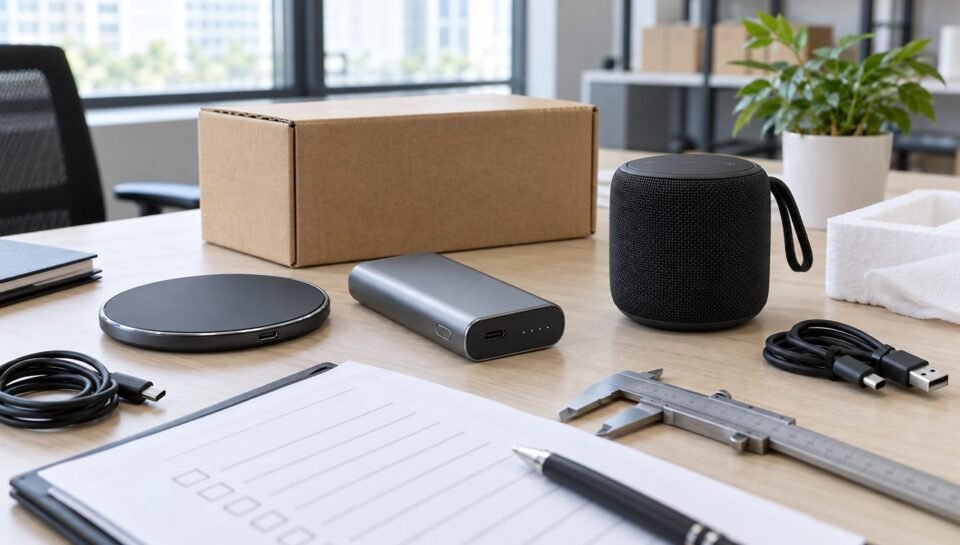
A three-item electronics gift set may arrive in one branded box, but the wireless charger, power bank and Bluetooth speaker inside it may come from three factories. Each has a different component list, test file, print surface and shipping constraint. Importers who quote the set as one generic ‘custom electronics’ product often discover those differences after the logo artwork is approved or the ship date is fixed.
The workable approach is to define each product separately, then control the kit as one order. Lock the electrical specification and production model first; approve the branding and package on that exact hardware; inspect the finished goods against the approved samples; and confirm the transport plan before releasing the balance. This guide focuses on those China-side buying decisions rather than treating a logo as the only customization step.
Choose the three products around one buyer brief
Begin with the recipients, destination market, budget, quantity and delivery date. A charger designed for desks has a different risk profile from a travel power bank. A speaker chosen for a conference room may need better microphone performance than an outdoor gift speaker. Ask the internal buyer which features matter in use, then record what is optional. That prevents a supplier from substituting a visually similar lower-spec model when a quoted chip or battery is unavailable.
| Product | Specification to lock before quoting | Sample test that catches common mistakes |
|---|---|---|
| Wireless charger | Qi or Qi2 claim, certified model ID if claimed, input and output rating, supplied cable and adapter | Charge target phones with common cases; check alignment, heat and intermittent charging |
| Power bank | Cell model, nominal voltage, mAh and Wh, USB-C input/output, protection circuit, port ratings | Measure charge/discharge behavior, heat, port fit and simultaneous-output limits |
| Bluetooth speaker | Driver, amplifier, battery, Bluetooth module, firmware, charging input and acoustic target | Pair and reconnect; compare sound, microphone if fitted, runtime and charging across samples |
A supplier’s catalogue title is not a specification. Write a model matrix with the factory’s internal model number, board revision, battery or cell code, port configuration, included accessories and retail SKU. The same shell can hide a different circuit board. If the factory offers several capacities or wattages in the same housing, treat each as a separate model until the test evidence shows which variants are covered.
Compare suppliers on execution, not only unit price
Ask each candidate whether it makes the complete product, buys finished electronics for printing, or acts as a trading company. None of those models is automatically wrong. What matters is who controls component purchasing, firmware, final testing, artwork, defects and replacement stock. A print shop may be excellent at logos but unable to answer a battery-cell substitution question. A factory may build a reliable product yet have weak experience with multi-SKU gift packaging.
- Request a quote by exact model, quantity break, logo process, packaging version, test scope and delivery term.
- Ask who owns the bill of materials and which components require written approval before substitution.
- Check whether the submitted reports name the factory’s production model, not a similar catalogue product.
- Confirm where finished goods will be inspected and whether an independent inspector can select cartons at random.
- Separate tooling, artwork plates, sample fees, tests, freight and rework allowances from the unit price.
If the order combines products from several suppliers, give one party responsibility for the final pack list and handover. A China warehouse can receive each line, check quantities and assemble kits after product-level approval. Our warehouse and logistics guide explains when that extra control is worth adding.
Wireless chargers: verify the claim behind the logo
For a charger promoted as Qi or Qi2 certified, ask for the exact model and WPC ID, then check the Wireless Power Consortium’s certified-product database. Certification of a charging coil or reference design does not automatically certify every branded end product. Confirm that the production electronics, housing and firmware are within the approved model scope, especially if the supplier changes the enclosure to fit a larger logo.
Test the approved sample with the phones and cases recipients are likely to use. Record alignment, charging stability, output under a suitable input supply and surface temperature during a sustained charge. A magnetic model needs a separate compatibility check: magnetic attachment is not the same as a guarantee of the advertised charging rate on every phone. Where USB-C or USB Power Delivery claims appear on packaging, compare the actual input/output table and any certification claim with the USB-IF certified-product listing or the relevant laboratory evidence.
For a deeper single-product RFQ, see our wireless charger sourcing guide. In a mixed gift program, the extra question is whether the charger, cable and any adapter will fit the shared packaging and destination-market requirements.
Power banks: make battery identity and freight part of the quote
A power bank’s advertised mAh does not state the energy available at its output port. Ask for nominal cell voltage, rated capacity, watt-hours, cell supplier and the conditions under which usable output was measured. Compare the USB-C input and output ratings, simultaneous-port limits, protection functions and charge time. A laser-engraved logo cannot compensate for an inflated capacity claim or an unstable port.
For promotional model choices, logo surfaces, retail packing and capacity examples, read RC Promotions’ custom promotional power banks guide. Its 5,000 mAh integrated-cable, 10,000 mAh dual-device and magnetic options illustrate how the recipient and packaging brief affect the model choice. Direct Sourcing China can then turn the selected configuration into a supplier, document and inspection brief.
Before deposit, obtain a UN 38.3 test summary linked to the actual cell or battery design, the battery specification and the forwarder’s route-specific document list. The IATA 2026 battery guidance treats power banks as lithium-ion batteries under UN 3480 for air cargo, not as an ordinary accessory packed with equipment. The applicable packing instruction, state-of-charge limit, marks and labels depend on the battery and shipment. Have a qualified freight partner confirm the final classification; passenger carry-on allowances are not a substitute for commercial cargo rules.
A battery change after the golden sample can invalidate the link between the product, its test summary and the shipping paperwork. Put cell model and pack configuration on the change-control list. For EU-bound orders, also map the current EU Batteries Regulation to the battery category and placing-on-market date rather than copying an old label from another model.
Speakers: keep the approved audio hardware behind the branded shell
A portable speaker can look identical from one production run to the next while its driver, amplifier, Bluetooth module or battery has changed. Ask for a controlled bill of materials and retain a signed or uniquely numbered golden sample. Include sound profile, maximum volume behavior, pairing, reconnection, microphone if fitted, charging, buttons and runtime in sample approval. A short listen at the factory is not enough to compare two batches.
For Bluetooth models sold in the United States, confirm the applicable FCC authorization for the final configuration. The FCC explains that intentional radiators generally require certification before marketing, while wireless charging functions have their own authorization analysis under wireless-power-transfer guidance. EU requirements depend on the model and market. Our Bluetooth audio compliance guide details how to match CE, FCC, RoHS and battery files to the exact hardware.
Treat artwork and packaging as controlled production data
Logo placement can affect more than appearance. A print over a speaker grille changes the finish and may muffle sound; a metallic decoration near a wireless charging area may affect performance; a power-bank label must leave mandatory battery information legible. Approve artwork on each real substrate and finish, not only a digital mockup. Record the logo size, position, color reference, print method, adhesion test and permitted registration tolerance.
- Use one final artwork file per product, retail box, manual and outer carton; include a revision number.
- Keep regulatory marks, model numbers, Wh ratings, warnings and importer details separate from decorative artwork.
- Check barcode content by scanning printed proofs and production packs, not by looking at the bars.
- Confirm that cable, adapter, charging instructions and language inserts match the quoted sales market.
- When items form a kit, test the tray and carton with all three products in place for scuffing, movement and compression.
For the EU, the European Commission’s importer guidance makes clear that importers must check the required documentation and conformity before placing products on the market. A custom logo or private label can change who carries manufacturer-level responsibilities. The RoHS rules also reach electrical and electronic components, so a finished-product housing report is not a complete evidence file for a three-item kit.
Approve samples and inspect finished goods by SKU
Keep a separate approval record for charger, power bank and speaker, then one for the assembled kit. Sign off the electrical model, battery or board revision, finish, logo and packaging. The purchase order should forbid unapproved substitutions and state what happens if a test, defect count or shipment document is missing. Tie the balance release to a finished-goods inspection and resolution of material nonconformities rather than to a factory’s statement that production is complete.
- Confirm that all three production lots are complete and identify any quantities not available for inspection.
- Select cartons across pallets and production dates; sample each SKU, color and print version rather than the kit total alone.
- Compare product model, ports, cell or battery codes, firmware where visible, speaker components and packaging with the approved records.
- Test charging, pairing, output, heat, logo rub resistance, barcode scan, accessories and pack-out using stated methods.
- Photograph failures with carton and batch references; classify defects and agree on sorting, rework or replacement before release.
- Reinspect corrected goods when the defect pattern is widespread or safety-related, and reconcile final carton counts with the freight booking.
Sampling rules should be agreed before the visit. Our pre-shipment inspection framework explains lot definition, defect classes and AQL decisions. For electronics, add functional and document checks that fit each product rather than applying only a cosmetic checklist.
How Direct Sourcing China and RC Promotions fit together
Direct Sourcing China manages the China-side sourcing execution: supplier comparison, RFQ and sample follow-up, production change control, pre-shipment quality checks and warehouse coordination. RC Promotions is closely connected and provides promotional product lines and customization references for gift programs. That division lets buyers explore branded options without losing control of the factory specification and shipment evidence.
If you are preparing a multi-item electronics order, send Direct Sourcing China the quantity by item, destination, target delivery date, artwork and current product shortlist. We can identify which decisions need a factory, laboratory, compliance specialist or freight forwarder before you commit to a production schedule.
Frequently asked questions
Sometimes, but verify which products it manufactures and which it buys for printing. Assign responsibility for specifications, testing, defects and final kit assembly for every SKU.
No. Match the exact production model and WPC ID to the Wireless Power Consortium database, and check that the branded housing and electronics remain within the certified model scope.
Start with the battery specification, exact-model UN 38.3 test summary and route-specific classification, packing, marks and labels confirmed by the freight partner. Market compliance documents are a separate check.
Approve them together on the final hardware. A digital logo proof cannot show surface adhesion, port clearance, speaker-grille interference or wireless charging behavior after decoration.
No. Inspection checks that sampled production goods and documents match approved requirements. It does not recreate radio, safety, battery transport or substance testing required for the destination market.