




How to Find a Reliable Bluetooth Speaker Manufacturer in China

Finding a Bluetooth speaker manufacturer in China is not hard. Finding one that can repeat the approved sample in mass production is the harder part. The market has plenty of suppliers, and many of them can send a nice photo, a quick quote and a sample within a few days.
The buyer’s job is to sort out who can actually control sound, battery, Bluetooth stability, waterproof claims, packaging and compliance. A weak factory may still make one acceptable sample. Problems usually appear when the order moves into materials purchasing, assembly, aging tests and final packing.
This guide focuses on supplier selection. If you need a wider buying checklist, read our related article: How to Source Bluetooth Speakers from China in 2026.
1. Decide what kind of manufacturer you need
Not every Bluetooth speaker factory is built for the same buyer. Some factories are strong at low-cost gift speakers. Some focus on outdoor waterproof models. Some handle private label orders with custom tooling and packaging. A few have better acoustic engineers and more serious testing rooms. The right choice depends on your product position.
- Ready-made model with logo: faster, lower development risk, easier for small or mid-size orders.
- Private label model: more control over color, packaging and minor features, but higher MOQ.
- OEM or ODM project: better for long-term product lines, but requires stronger engineering and project control.
- Waterproof or outdoor speaker: needs closer checks on sealing, drop resistance, materials and battery safety.
- Premium audio product: supplier needs better driver selection, acoustic tuning and consistent assembly control.
A common sourcing mistake is asking every supplier for the same target price before defining the product level. A $6 promotional speaker and a $28 outdoor speaker are not judged by the same standard. Start with the market, then filter suppliers.
2. Check whether the supplier is a real fit, not just a real company
A supplier can be legally registered and still be the wrong choice. For Bluetooth speakers, you need to know what they do in-house. Do they assemble the product? Do they control PCB design? Do they buy standard speaker drivers and batteries from outside vendors? Do they have aging racks, Bluetooth test tools, battery test equipment and basic acoustic testing?
Ask for a factory profile, but do not stop there. Request photos or short videos of the assembly line, speaker driver incoming inspection, battery storage, aging test area, packing line and sample room. If the supplier avoids these simple checks, that tells you something.
Supplier identity checks should also include the legal company name and payment account. For the risk side, see How to Avoid Supplier Scams When Sourcing Products from China.
3. Ask about Bluetooth qualification before the order gets serious
A Bluetooth speaker uses Bluetooth technology, so buyers should understand how the supplier handles Bluetooth qualification. The official Bluetooth SIG explains qualification through its Bluetooth Qualification Process. If a supplier says the product is Bluetooth qualified, ask for the Declaration ID, Qualified Design ID or related qualification details that match the product design.
This is not paperwork for decoration. It affects brand use, distributor review and compliance confidence. Some suppliers use modules or reference designs from other vendors. That can be normal, but the supplier should be able to explain the design path clearly.
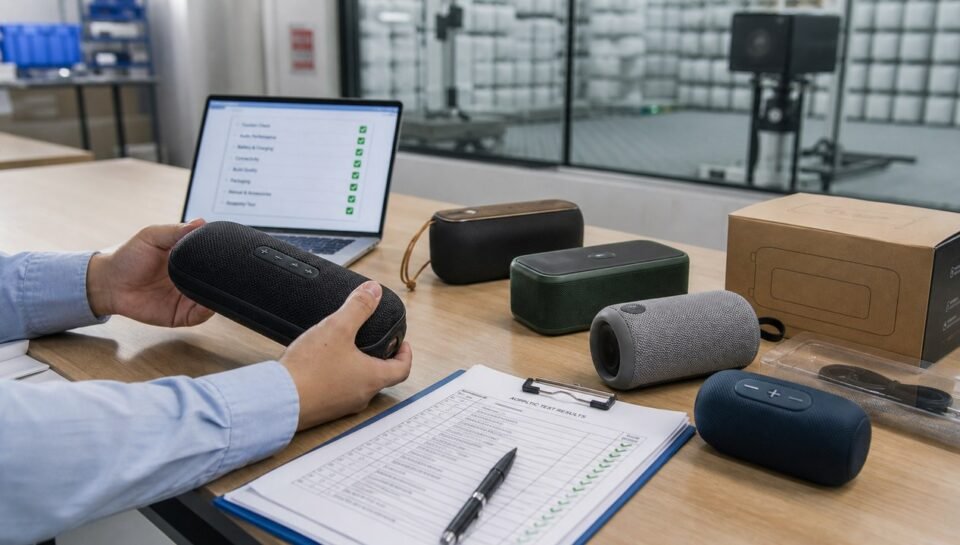
4. Compare samples with a simple test routine
A Bluetooth speaker sample should be tested like a product, not admired like a catalog item. Test it with the phones and music sources your customers use. Pair it several times. Walk away from the speaker and see where the signal weakens. Charge it, drain it, charge it again. Listen at low volume and high volume. Check whether the cabinet rattles when bass hits.
- Bluetooth pairing speed and reconnection behavior
- Stable playback distance in a normal office or home environment
- Battery runtime at a stated volume level
- Charging time, charging port fit and cable quality
- Sound balance, distortion, bass rattle and microphone quality if included
- Button feel, LED behavior, voice prompts and app support if any
- Cosmetic finish, fabric glue, grille alignment and rubber parts
Keep notes for every sample. If three suppliers all claim the same battery capacity but one unit runs much shorter, you have an early warning. If the supplier cannot explain the difference, do not expect mass production to improve by itself.
5. Do not accept vague BOM answers
The bill of materials is where many Bluetooth speaker quotes become unclear. Two speakers can look almost identical but use different drivers, amplifier ICs, batteries, microphones, charging ports, fabric, plastic material and packaging. Those differences decide cost and quality.
You do not always need the factory to reveal every confidential supplier name, but you do need enough detail to compare quotes honestly. Ask for driver size, rated power, battery capacity, charging input, Bluetooth chipset series, waterproof rating if claimed, material, accessories and packaging specification. If the supplier refuses to write basic specs into the PI, the low price is risky.
6. Check compliance documents for the destination market
Certification requirements depend on where the product will be sold. For the U.S., Bluetooth speakers usually need attention to FCC requirements for radiofrequency devices. The FCC explains equipment authorization on its official RF device page. For Europe, buyers commonly check CE marking and RoHS. The European Commission provides official pages for CE marking and the RoHS Directive.
Most rechargeable Bluetooth speakers also contain a lithium battery, so transport documents matter. Ask for battery specifications, UN38.3 test evidence when needed, MSDS or SDS, and packing information before the shipment plan is locked. If your sales channel is strict, check documents before sampling, not after production.
7. Visit or audit the factory for serious orders
A local factory visit does not need to be complicated. The goal is to check whether the supplier’s story matches reality. Is there active production? Are similar products being made? Are workers using test fixtures? Are finished goods separated from rejected goods? Are batteries stored properly? Is the packing area organized?
For larger orders, a short supplier audit can save a lot of guesswork. It can also reveal whether the company is mainly an assembler, trader, mold shop, audio product specialist or general electronics supplier. Each type can be useful, but the buyer should know which one they are hiring.
8. Put quality control into the purchase order
Quality control should not start at final inspection. It should be written into the order. Include the approved sample, color standard, logo artwork, packaging layout, function tests, battery runtime test method, cosmetic defect limits, carton drop requirement if needed, and balance payment condition.
For Bluetooth speakers, pre-shipment inspection should normally check appearance, quantity, packaging, labels, Bluetooth function, charging, playback, controls, accessories, battery information and basic workmanship. If the product claims IPX waterproof performance, the test method must be agreed before production.
You can also use our Bluetooth Speaker Quality Inspection Checklist for Importers as a starting point.
9. Reliable does not always mean the biggest factory
Large factories can be stable, but they may not care about smaller orders. Smaller factories can be flexible, but they may need closer control. A reliable supplier is the one whose capability matches your order size, technical difficulty, quality standard and communication needs.
The best sign is not a perfect sales pitch. It is boring, useful consistency: clear answers, written specifications, honest limits, repeatable samples, complete documents and a willingness to fix issues before shipment.
How Direct Sourcing China can help
Direct Sourcing China works with importers who need supplier screening, sample follow-up, quality inspection, compliance document review and shipment coordination in China. Bluetooth speakers are a category where local checks matter because sound, battery, wireless performance and packaging all need to work together.
If you are comparing Bluetooth speaker manufacturers in China, we can help shortlist suppliers, check samples, visit factories, review documents and arrange pre-shipment inspection before you release the balance payment. You can review our sourcing and inspection services or contact us with your product brief.
FAQ
Many portable Bluetooth speaker suppliers are in Guangdong, especially Shenzhen, Dongguan, Huizhou and Guangzhou. Some suppliers are real factories, while others are trading companies or assembly partners, so location alone is not enough.
Ask for the Chinese business license, factory address, production process photos, testing equipment list, sample room details and recent production videos. For larger orders, arrange a factory audit or local visit.
Test Bluetooth pairing, audio performance, battery runtime, charging safety, button feel, waterproof claim if any, drop resistance, packaging strength, cosmetic quality and consistency between samples.
Usually yes. Requirements depend on the market, but buyers often check Bluetooth qualification, FCC for the U.S., CE and RoHS for Europe, plus battery and transport documents when the speaker has a rechargeable lithium battery.
Not for serious orders. A very low quote may mean a weaker battery, smaller driver, cheaper amplifier, thin packaging or missing certification. Compare the BOM and test results, not only the unit price.





1 Comment
Bluetooth Speaker Factory Audit in China: What Importers Should Check - Professional in Auido Products | Best China Sourcing Agent of Best
August 22, 2026[…] This article focuses on factory audit. If you are still shortlisting suppliers, start with How to Find a Reliable Bluetooth Speaker Manufacturer in China. […]